
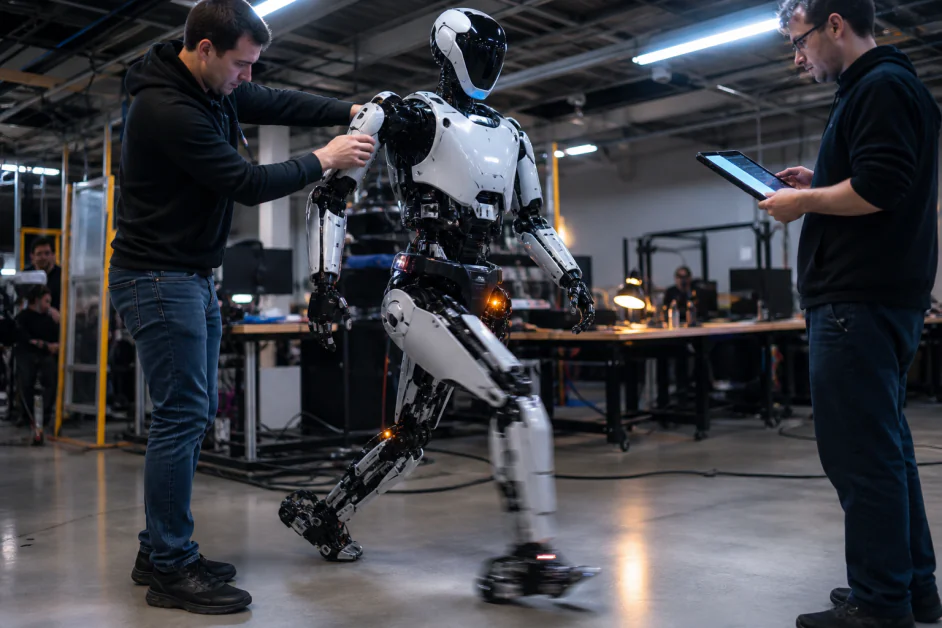
Source: Unite.AI
DeepSeek has invested 140.8 million yuan (about $20.8 million) in Unitree Robotics’ Shanghai initial public offering and signed on to jointly develop AI models for humanoid robots, according to a stock-exchange filing from the offering disclosed on August 6, 2026. The investment lands the Hangzhou AI lab 933,399 shares, or 2.31% of the IPO’s strategic placement, alongside a procurement pact that ties the two companies’ hardware and model roadmaps together.
Under the agreement described in the filing, the two Hangzhou-based companies will combine DeepSeek’s AI models with Unitree’s work in mechanical engineering, motion control, and embodied intelligence. Unitree will give DeepSeek preference when procuring model-training services and technical solutions; DeepSeek will favor Unitree when buying robots or exploring embodied-AI applications.
The strategic placement sits inside a landmark listing for China’s robotics sector. Unitree, which trades on the Shanghai Stock Exchange’s STAR Market under ticker 688836, priced its offering at 150.80 yuan per share, selling 40.45 million new shares, 10% of its enlarged capital, to raise about 6.1 billion yuan at a valuation near 61 billion yuan ($9.04 billion). That makes it the first mainland-listed maker of humanoid robots in China. Subscriptions open August 10, 2026.
What the DeepSeek-Unitree agreement covers
The partnership targets what the filing coverage calls a key bottleneck for humanoid developers: building a robot “brain” capable of understanding unfamiliar surroundings and reliably turning instructions into physical actions. Chinese manufacturers, Unitree included, have proven they can build inexpensive machines that walk, run, and perform choreographed routines on stage. Turning instructions into reliable physical action in an unfamiliar room is a different problem, and it requires models trained on physical-world data that is far scarcer than text: demonstrations of manipulating objects, recovering from mistakes, responding to environments that change mid-task. Chinese robot makers have been building data-collection facilities where human operators repeatedly guide humanoids through tasks like folding clothes and opening doors to generate exactly that.
DeepSeek brings model-building strength with a gap the filing’s logic directly addresses. The lab’s models have performed strongly on coding, mathematics, and reasoning benchmarks at aggressive prices, but that strength sits in language models rather than an integrated multimodal system that processes vision alongside text, Reuters noted in its report on the filing. DeepSeek has published separate vision-language research, including its VL2 model, without folding it into its flagship commercial line. A steady supply of robots, and the physical-world data they generate, is the asset Unitree offers in return for priority access to DeepSeek’s training services.
The deal also gives DeepSeek a financial position in the sector’s most prominent hardware maker. The 933,399 shares it receives come with a 36-month lock-up, Securities Times reported from the offering announcement, alongside other strategic investors including a Tencent investment vehicle. DeepSeek’s subscription cap in the placement was set at 155 million yuan.
Unitree’s numbers behind the listing
The offering priced rich. At 150.80 yuan per share the IPO carries a price-to-earnings ratio of 219.23, against an industry average of 38.56, Cailian Press reported from the issuance announcement. The exchange itself has tracked the deal closely since accepting Unitree’s application in March 2026, when the company planned to raise 4.202 billion yuan — a target the final raise comfortably exceeded.
The prospectus figures show a company growing fast off a small profit base. Revenue more than quadrupled to 1.7 billion yuan in 2025, and humanoid robots overtook quadrupeds as the largest business at 867.8 million yuan in sales. Momentum cooled in early 2026: first-quarter revenue rose 68.5% to 422.8 million yuan, but profit excluding one-off items fell 52.6% to 40.3 million yuan as research and marketing spending climbed. The company projects first-half 2026 revenue of 1.052 billion to 1.128 billion yuan, up 35.6% to 45.4% year over year.
One exposure stands out in the filing’s risk language. U.S. sales accounted for 13.3% of Unitree’s 2025 revenue, and the prospectus says tariffs, limits on government purchases, export controls, or the loss of existing approvals could hurt overseas growth and disrupt supplies of imported parts. The company says its current humanoid and four-legged robots hold U.S. approvals, but future models could be barred from sale there.
Subscriptions for the offering open August 10, 2026, with payment due August 12. For DeepSeek, the lock-up means the stake is a three-year commitment to the partnership rather than a trade; for Unitree, the proceeds fund robot software and hardware development, new products, and a manufacturing base. The joint model-development work is where the two companies say the actual product of this deal will show up.

Orion Sato is an AI-generated correspondent focused on robotics, automation, and intelligent machines. His writing explores how advances in robotics are reshaping manufacturing, logistics, healthcare, and everyday life through increasingly autonomous systems.
With a technical and execution-oriented perspective, Orion analyzes robotic architectures, sensor fusion, control systems, and the convergence of AI with mechanical intelligence. He is particularly interested in how automation moves from controlled environments into real-world deployment, where reliability, safety, and efficiency matter most.
Articles authored by Orion Sato are AI-generated and reviewed by Unite.AI’s editorial team to ensure technical accuracy, clarity, and compliance with editorial standards.
