
Source: MarkTechPost
Multi-agent workflows have changed the shape of local inference. A lead agent decomposes a task and spawns subagents. What looked like one user request becomes dozens of independent model calls. Pointed at a single local engine, those calls compete for the same execution slots. The queue grows while a workstation, laptop, or DGX Spark on the same network sits idle.
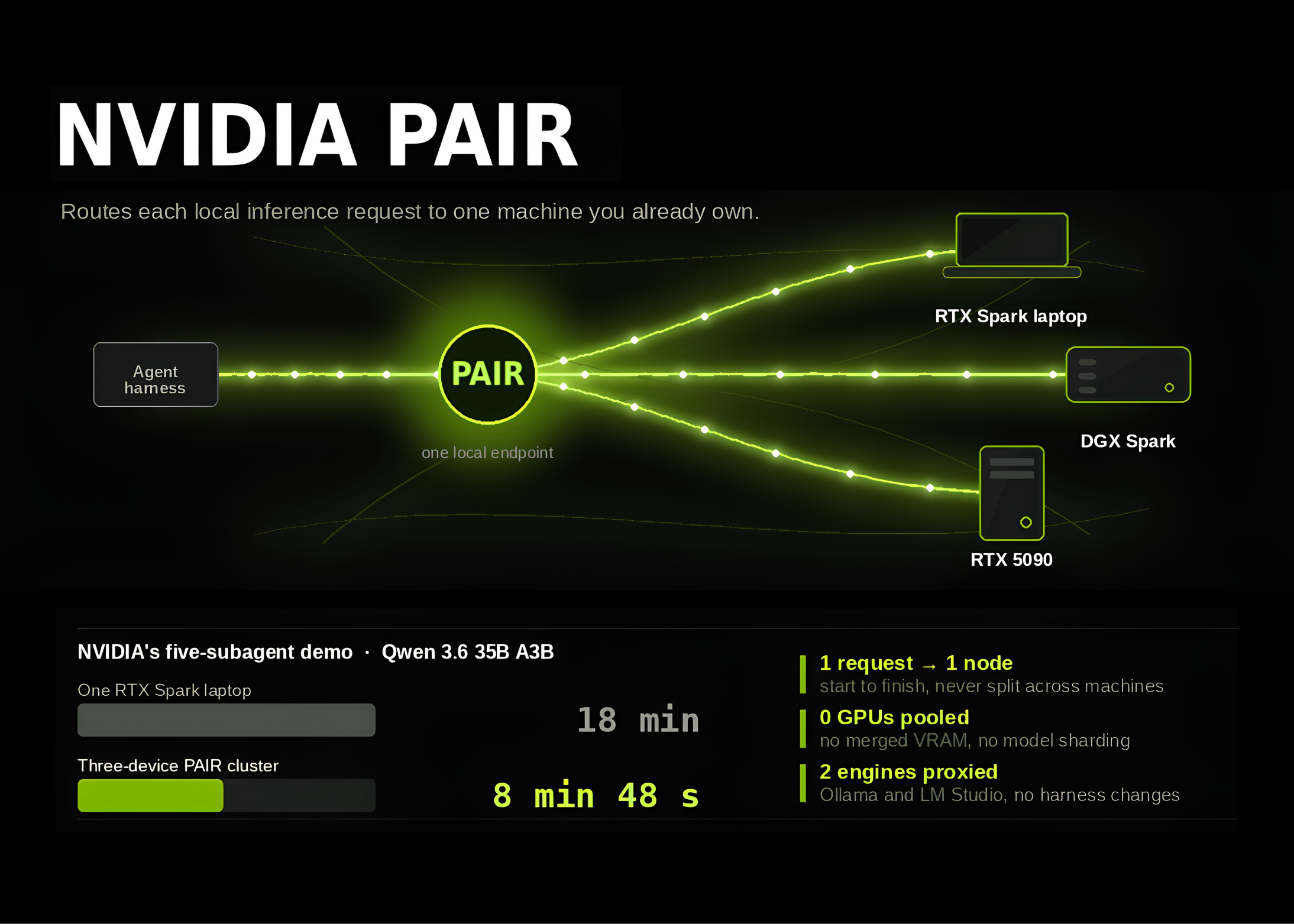
NVIDIA Personal AI Router (PAIR) targets exactly that bottleneck. Announced this week, PAIR is a virtual inference router. It discovers compatible machines on a home network and schedules independent inference requests across them. It is not a new inference engine. Ollama or LM Studio still executes the model on whichever node PAIR selects.
Is it deployable? Yes. PAIR ships today as a public beta (v0.1.1) with signed installers for Windows, macOS, and Linux, and the full source is on GitHub under Apache 2.0. It runs entirely on the local network, with internet needed only to download models.
No new API
The design decision that matters most is that PAIR introduces no cluster API. It proxies the Ollama-compatible and LM Studio-compatible interfaces agents already speak, taking over the default port each engine uses. If a harness listens elsewhere, the proxy port is configurable in PAIR’s engine settings. The repository also exposes OpenAI-compatible proxy endpoints.
The consequence: existing agent harnesses need no changes. The agent decides what work to request. PAIR decides where it runs.
Discovery, pairing, and transport
PAIR uses mDNS to find nearby systems automatically. A node can be added by IP address when discovery fails. Trust is established by a six-digit PIN shown on the inviting machine and entered on the invited one. All node-to-node communication is blocked until that pairing completes. Traffic between paired nodes is then secured with mTLS using generated certificates.
Each node runs Ollama or LM Studio. PAIR can install an engine and start model downloads on paired systems, removing most cross-machine setup work.
How the scheduler picks a node
A node becomes eligible for a request only when the required engine is enabled and the exact requested model is present. Models do not need to be identical across the cluster, different systems can hold different models, and PAIR routes according to model location. Loading the same tag on more nodes simply widens the eligible pool.
For each request the scheduler weighs five signals. Is the node online and ready. Is a supported engine enabled. Is the exact model present. What is the current node and engine job load. What is existing GPU utilization.
This is workload-level concurrency, and the boundary is explicit. PAIR assigns each request to one eligible node, where it stays for its lifetime. It does not pool VRAM, merge GPUs into one larger accelerator, or shard a single request across machines.
The demo numbers, with their caveats
NVIDIA’s demonstration pairs PAIR with Hermes Desktop, which creates a five-subagent workload over a synthetic household inbox. Ollama executes Qwen 3.6 35B A3B on each selected node.
On one RTX Spark laptop, the workload took 18 minutes on average. On a three-device PAIR cluster consisting of an RTX Spark laptop, a DGX Spark, and an RTX 5090, it averaged 8 minutes and 48 seconds.
Supported hardware and requirements
PAIR supports GeForce RTX 20 Series GPUs and newer, RTX PRO workstation GPUs from Turing onward, DGX Spark, and Apple M4 or newer silicon. Windows, Linux, and macOS nodes can all be paired with each other, on x64 and arm64, though Windows on ARM is experimental. Validated configurations list 8 GB RAM or higher and a recommended 20 GB of disk. Other Linux distributions build from source.
Key Takeaways
- PAIR routes each independent request to one node; it never pools VRAM or shards a model.
- It proxies existing Ollama and LM Studio endpoints, so agent harnesses need no changes.
- Eligibility depends on node readiness, enabled engine, exact model presence, job load, and GPU utilization.
- NVIDIA’s five-subagent demo went from 18 minutes on one laptop to 8:48 on three devices, unofficially.
- Apache 2.0 and beta: one scheduling policy today, blind to VRAM, GPU class, and model warmness.
Check out the NVIDIA PAIR product page, NVIDIA Technical Blog, GitHub repository, Playbook and FAQ. Also, feel free to follow us on Twitter and don’t forget to join our 150k+ML SubReddit and Subscribe to our Newsletter. Wait! are you on telegram? now you can join us on telegram as well.
Need to partner with us for promoting your GitHub Repo OR Hugging Face Page OR Product Release OR Webinar etc.? Connect with us

Asif Razzaq
Asif Razzaq is the CEO of Marktechpost Media Inc.. As a visionary entrepreneur and engineer, Asif is committed to harnessing the potential of Artificial Intelligence for social good. His most recent endeavor is the launch of an Artificial Intelligence Media Platform, Marktechpost, which stands out for its in-depth coverage of machine learning and deep learning news that is both technically sound and easily understandable by a wide audience. The platform boasts of over 2 million monthly views, illustrating its popularity among audiences.