
Source: MarkTechPost
Flet is an open source Python framework that renders its UI with Flutter. You write Python, and Flet draws Material and Cupertino widgets on iOS, Android, Windows, macOS, Linux and the browser. No Dart, Swift, Kotlin or JavaScript required.
Last week, the Flet team released Flet 1.0 and declared it ready for building production apps. The release lands roughly four years after the project started.
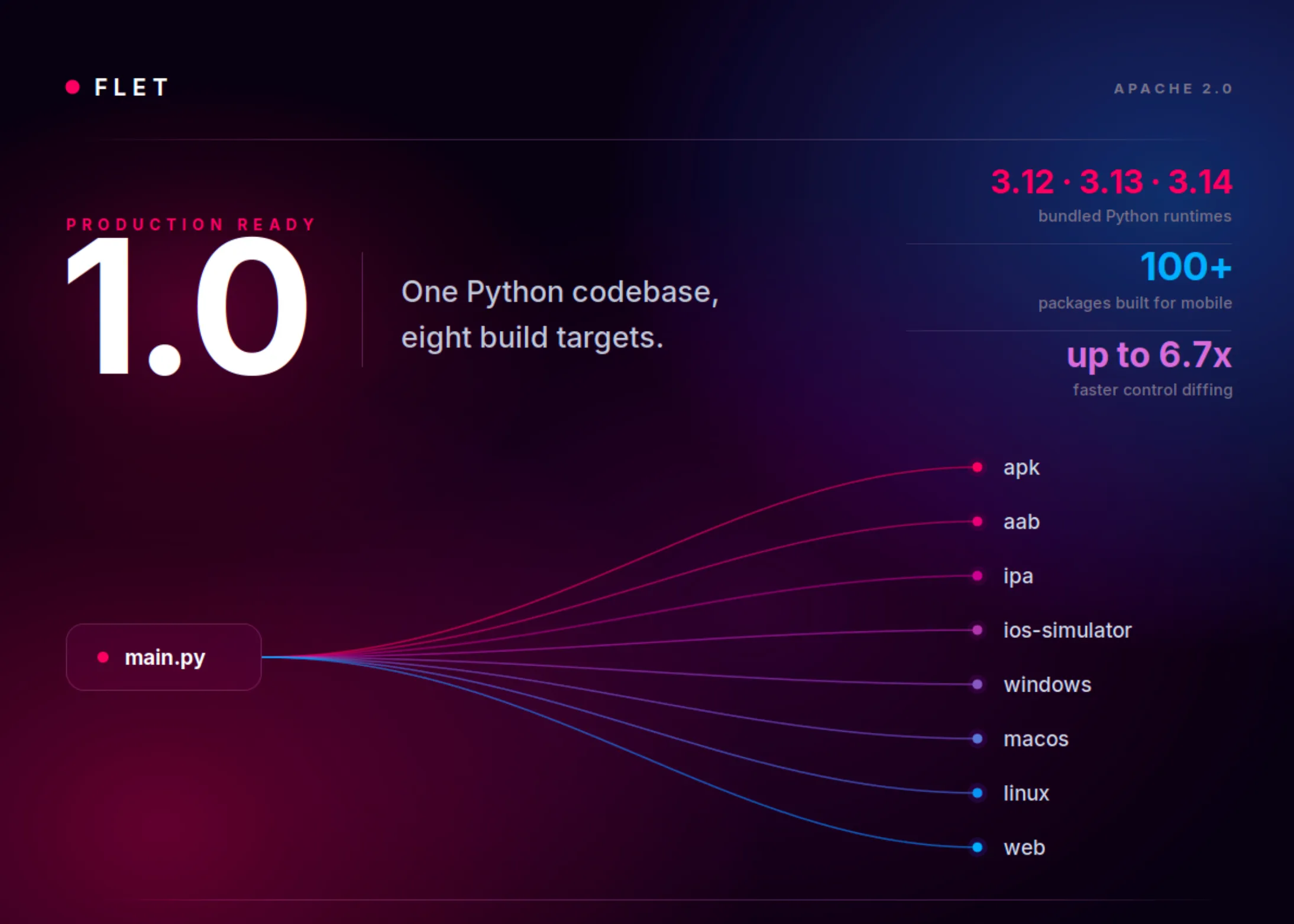
Is it deployable? Yes, today. Flet 1.0.0 is on PyPI under the Apache 2.0 license, requires Python 3.10 or newer for the SDK, and installs with pip install 'flet[all]'. flet build produces artifacts for Windows, macOS, Linux, iOS, Android and web. The CLI accepts eight target platforms: apk, aab, ipa, ios-simulator, windows, macos, linux and web.
The Test Matrix
Flet runs framework unit tests across Python 3.10 to 3.14, alongside tests for the Flutter side. Control and example integration tests check behavior and compare screenshots, catching functional bugs and visual regressions.
Python binary package tests exercise native libraries on Android and the iOS simulator, with the mobile pipeline building for Python 3.12, 3.13 and 3.14. flet build integration tests compile apps across those Python versions for all six platforms, and flet test launches a packaged app and drives it on all five native platforms, including Linux ARM64.
You can write the same kind of tests. Integration tests for your own app use pytest, run via flet test against the packaged build, with screenshot comparison on Android and iOS.
Python Versions and Mobile Libraries
Flet bundles Python 3.12, 3.13 or 3.14 with your app, and web builds use the corresponding Pyodide release. See how to choose a Python version.
The Flet package index now lists more than 100 packages, including NumPy, pandas, Matplotlib, Pillow, SciPy, scikit-learn, cryptography and pydantic-core, plus supporting native libraries. The mobile-forge pipeline automates wheel builds for iOS and Android. Availability still depends on the package and the target.
Performance and Packaging
Flet now tracks changed properties and skips unnecessary comparisons during UI reconciliation, with 0.83 benchmarks measuring up to 6.7x improvement in control diffing. In packaged native apps, dart-bridge lets the Python and Dart runtimes talk inside one process, without sockets, with dedicated channels for binary data.
Packaging enables bytecode compilation by default, and redesigned Android packaging loads Python packages directly from the APK without extraction.
Declarative UI
Flet Declarative describes UI as a function of application state, organized into reusable components. Flet Studio and the Flet mobile app are themselves declarative Flet apps. The imperative style remains supported. Compare both in the docs.
The compatibility policy deprecates APIs before removal, with a default deprecation period of three minor releases.
The Flet MCP server gives AI coding assistants version specific Flet API information, plus tools for finding examples, icons and CLI options. Flet Studio runs in the browser with a built in AI agent, and projects can be downloaded for local development.
Interactive Explainer
The embed below walks through five mechanics: the build pipeline across eight targets, declarative versus imperative state, the CI test layers, runtime bundling with mobile wheels, and the event loop trap. Colors follow Flet’s own brand tokens.
Key Takeaways
- Flet 1.0.0 ships on PyPI under Apache 2.0, Python 3.10 or newer for the SDK.
flet buildtargets eight platforms: apk, aab, ipa, ios-simulator, windows, macos, linux, web.- Bundle Python 3.12, 3.13 or 3.14, with 100 plus packages available for mobile.
- Control diffing measured up to 6.7x faster, and dart-bridge removes socket overhead.
- Upgrading from 0.28 is a real migration: handlers now run on one event loop.
Check out the Flet 1.0 release announcement. All credit goes to the researcher of this project. Also, feel free to follow us on Twitter and don’t forget to join our 150k+ML SubReddit and Subscribe to our Newsletter. Wait! are you on telegram? now you can join us on telegram as well.
Need to partner with us for promoting your GitHub Repo OR Hugging Face Page OR Product Release OR Webinar etc.? Connect with us

Michal Sutter
Michal Sutter is a data science professional with a Master of Science in Data Science from the University of Padova. With a solid foundation in statistical analysis, machine learning, and data engineering, Michal excels at transforming complex datasets into actionable insights.