
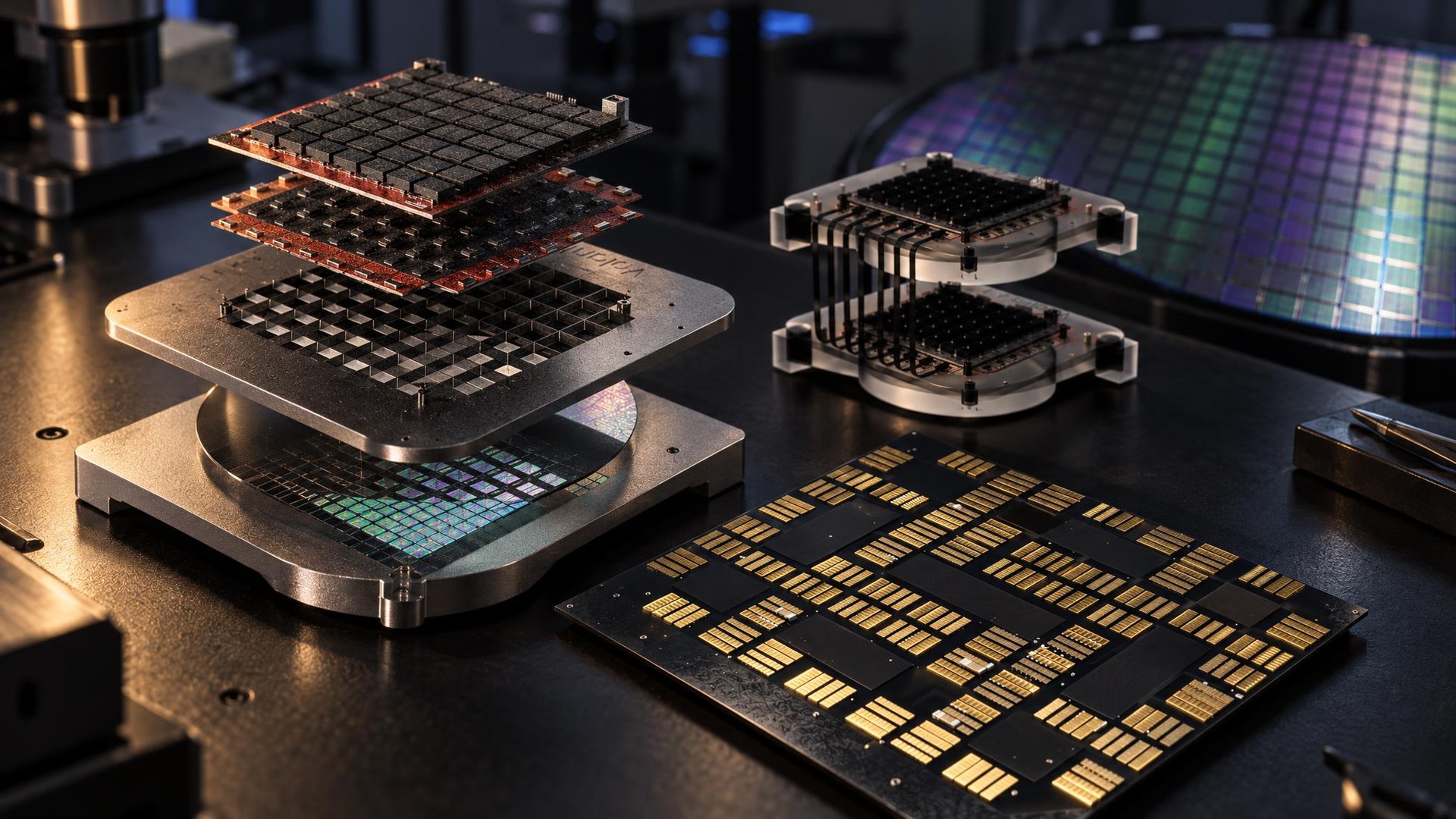
Source: Unite.AI
Volantis, a San Francisco semiconductor company building a new category of AI inference system, announced an $88 million Series A on October 1, 2026, co-led by Lachy Groom and Abstract Ventures, to fund development and commercialization of its photonic A-1 system.
The round drew participation from John Doerr, VXI Capital, Triatomic and Susa Ventures, with angel investors Dwarkesh Patel, Naveen Rao and Sholto Douglas also joining. Volantis said the financing brings its total funds raised to $97 million to date, a total that includes backing from Sam Altman, Jeff Dean, Dylan Patel and John Doerr, among others.
The company said the new capital will support development and commercialization of A-1 and its photonic memory architecture, including expanding its engineering team and moving the system toward customer deployments. Volantis plans to deliver its first integrated inference engines to customers in 2027.
Chief executive and co-founder Tapa Ghosh said current hardware forces a tradeoff between running the largest, most sophisticated models and running them fast, and that Volantis was started to eliminate that tradeoff. He added that as AI agents take on more work, how fast they complete that work will increasingly determine how fast companies can operate.
The A-1 System and the Memory Wall
Volantis describes a memory wall in current AI hardware: on-chip SRAM provides high bandwidth but limited capacity, constraining model size and context windows while increasing cost and energy consumption, while GPUs and other HBM-based systems provide greater capacity but see bandwidth limit how quickly they can serve increasingly large models. Even newer approaches such as 3D DRAM remain on the same tradeoff curve, the company said.
Volantis said it is designing A-1 to increase memory capacity and bandwidth simultaneously by nearly two orders of magnitude. The system is being designed to run models exceeding 20 trillion parameters at up to 10,000 tokens per second per user while reducing inference cost per token. The company said that performance could, as one example, let a coding agent complete a task in two minutes instead of 30, giving developers more opportunities to test ideas and iterate.
On its A-1 product page, Volantis lists 10 TB of memory capacity, 240 TB/s of memory bandwidth, a 20kW power envelope, 10 TB/s of off-wafer IO bandwidth and a 15U form factor intended to fit existing datacenter racks. The company said the first product integrates licensed, silicon-proven compute engine IP from external parties with its proprietary photonics, which it has developed for more than four years. The product page also states that A-1 delivers 15 times better tokens per dollar than NVIDIA Rubin, six times better tokens per watt for low-latency mixture-of-experts models above one trillion parameters, and more than 30 times lower latency for large-model inference.
Photonic Interconnect Design
Volantis describes its work as a new category of photonic interconnect designed specifically to connect compute chips to memory. Its optical fabric connects large numbers of memory chips into a unified pool, aggregating their bandwidth as memory is added, which the company said lets A-1 grow capacity and bandwidth together while using lower-cost off-chip memory.
The company noted that photonics already moves data inside data centers but has largely focused on chip-to-chip connections, while chip-to-memory connections require more than 100 times as much data to travel over much shorter distances, creating different energy and cost requirements. For that environment, Volantis said it built a photonic platform using custom micro-VCSELs rather than external lasers, drawing on the existing gallium arsenide VCSEL supply chain and avoiding indium phosphide supply constraints. It describes the micro-VCSELs as small, temperature-stable and low power, enabling end-to-end links consuming less than one picojoule per bit.
On its technology page, the company lists links running at 24G per lane with sub-five-nanosecond latency, scaling to tens of thousands of lanes for more than 200 TB/s of aggregate bandwidth, with integrated waveguides more than 2,500 times smaller than optical fiber. Electrical interconnects reach roughly two to five millimeters, the page states, while the company’s optical waveguides reach beyond 200 millimeters, allowing more than 220 memory chiplets to be connected in a single uniform-latency memory pool. The page also states the links remain thermally stable above 95 degrees Celsius with a bit error rate below 1e-12 at wafer scale, and it describes the design as the world’s first optical interposer with no external lasers.
Founding Team and Backers
Volantis said its founding team includes semiconductor and photonics veterans from NVIDIA, AMD, Broadcom and Ayar Labs whose previous work includes the first CoWoS product, the first high-volume tunable VCSELs and early silicon photonics co-packaged optics systems.
The company’s about page identifies Ghosh as a Thiel Fellow and former Y Combinator founder with four patents. It names co-founder and chief technology officer Roy Meade, who led Micron’s HBM program and previously served as a vice president at Ayar Labs; director of packaging Inderjit Singh, who built the industry’s first CoWoS product; vice president of engineering Daniel Klowden, who built the world’s first processor with direct optical communication; and director of laser engineering Chris Chase, who took a new VCSEL laser category to volume production.
The page also lists company backers including OpenAI chief executive Sam Altman, Google chief scientist Jeff Dean, SemiAnalysis founder Dylan Patel, Meta chief AI officer Alex Wang, Kleiner Perkins chairman John Doerr, AngelList founder Naval Ravikant, Hugging Face co-founder Thomas Wolf, Y Combinator co-founder Trevor Blackwell and OS Fund founder Bryan Johnson.
Volantis said it plans to unveil additional innovations behind the architecture as A-1 moves toward commercialization.