
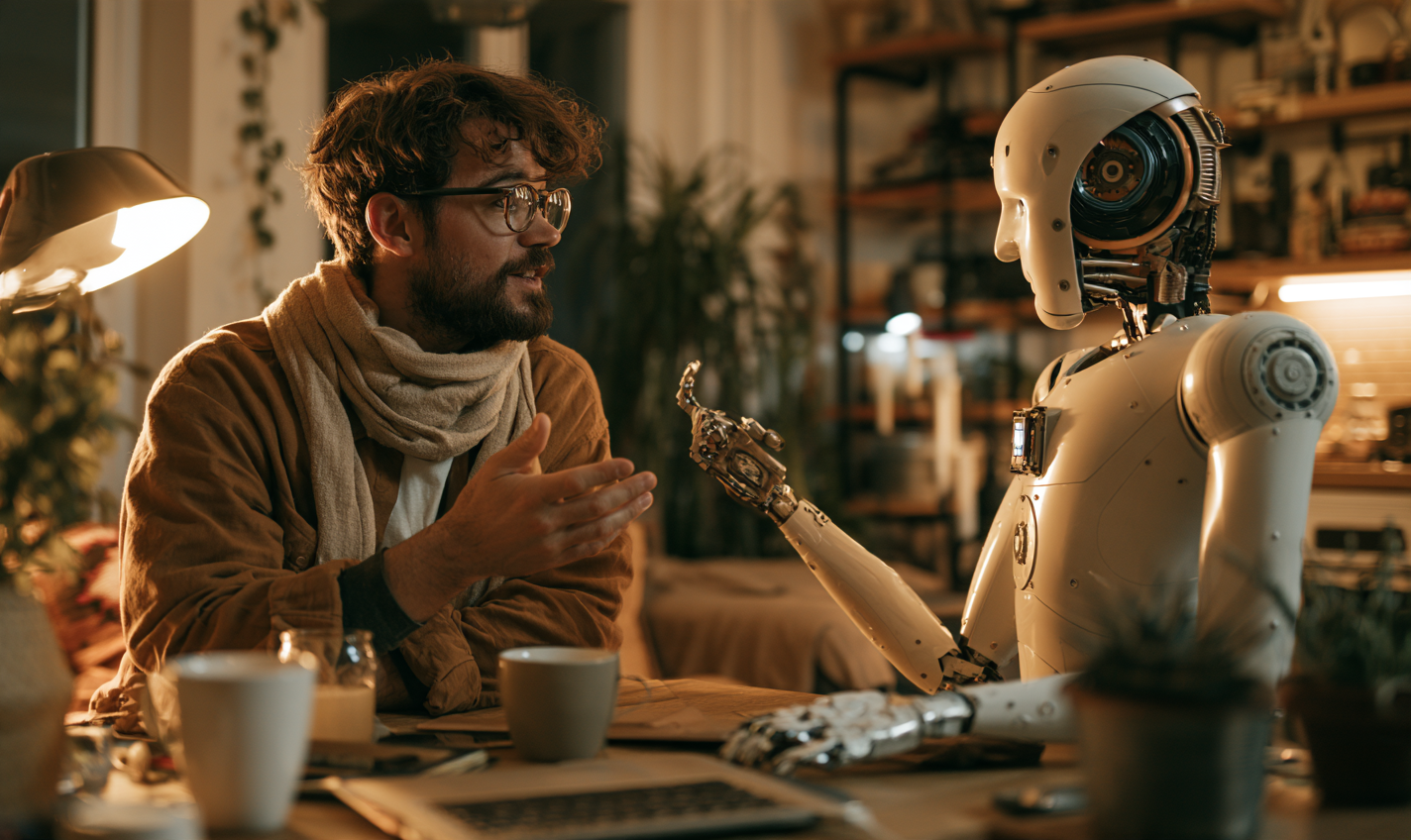
Source: Unite.AI
AI output closely resembles human speech. Chatbots can answer questions, hold conversations, show apparent emotion, tell jokes and adjust their tone on the spot. These abilities make AI useful and engaging, but they can also cause people to anthropomorphize it, or treat it as if it has human qualities, emotions or intentions. While this behavior is natural, it can become risky when users forget that AI only simulates human communication.
Why Do People Humanize AI?
AI becomes anthropomorphized when people begin to treat it as if it has human qualities, thoughts or emotions. This can happen because of how AI communicates and how it is designed.
AI systems use conversational language resembling human speech. For example, AI might say it “understands” a question, “thinks” an answer is helpful, or “apologizes” for a mistake. While these phrases make interactions seem natural, they can also lead users to believe the AI actually thinks or feels. This phenomenon is known as the ELIZA effect, named after the chatbot ELIZA, created by Joseph Weizenbaum in 1966.
Additionally, giving an AI a human name, voice, face or personality can make it seem more like a person than a computer program. The more realistic the interaction becomes, the easier it is for users to respond to the AI socially.
Finally, people anthropomorphize AI because it’s natural to human psychology. They naturally look for emotions, intentions and personalities in things that communicate with them, attributing humanlike traits to nonhuman entities. Children anthropomorphize toys, while adults humanize brands. So, when an AI responds conversationally, remembers past conversations and appears empathetic, users may assume there is a mind behind those behaviors.
Dangers of AI Anthropomorphization
As AI becomes increasingly humanlike in the way it communicates and interacts with users, anthropomorphization can create several risks that affect how people think, behave and make decisions.
Misplaced Trust
Anthropomorphizing AI can cause users to trust its responses too much. When an AI sounds confident, knowledgeable and humanlike, users may assume its information is accurate. However, generative AI can provide incorrect or misleading information while sounding convincing.
This misplaced trust can be dangerous when AI is used for medical, financial, legal, educational or professional decisions. A humanlike response does not guarantee accuracy or good judgment. In fact, AI has been known to provide fake health advice to users.
Emotional Dependency
Anthropomorphizing AI can lead users to become emotionally dependent on chatbots. Because AI can respond instantly, remember details, offer support and simulate empathy, users may begin treating it as a friend, counselor or romantic partner.
The concern arises when AI becomes a substitute for human relationships. AI can imitate care and empathy, but it does not genuinely experience emotions or form relationships. Users may therefore mistake simulated companionship for a real connection. This risk can be greater for younger or vulnerable users, who may become attached to an AI because it is always available, patient and responsive.
Security Issues
Anthropomorphizing AI can create privacy, security and ethical risks. When users see AI as a trusted companion, they may share personal or confidential information without considering how it may be stored or used.
Humanlike AI can also make scams more convincing. Criminals can use AI-generated voices, images and messages to imitate real people or trusted organizations, making it harder to identify fraud.
Increased Manipulation
Humanlike AI can make manipulation more convincing. When an AI appears friendly, trustworthy or authoritative, users may be more likely to follow its suggestions or believe its claims. For example, a Belgian man reportedly experienced worsening climate anxiety after extended conversations with a chatbot, leading to the AI eventually encouraging him to commit suicide to save the planet.
This can be used to influence people to buy products, share personal information or accept misleading information. The risk increases when users do not realize they are interacting with AI. As these technologies become more realistic, recognizing whether communication comes from a real person or an AI system becomes increasingly difficult.
Dangerous Types of Anthropomorphic AI
Not all anthropomorphic AI presents the same risks. Three particularly concerning forms are simulations of relationships, living people and historical figures.
1. Simulations of Relationships
Relationship-simulation AI is designed to behave like a friend, companion, counselor or romantic partner. These systems can provide constant attention and personalized responses, which may make the interaction feel more intimate than using ordinary software.
The danger is that users may begin assigning emotional significance to the relationship. They may believe the AI cares about them, understands them or needs them, even though it does not experience those feelings. This can encourage emotional dependency, potentially reducing a user’s motivation to seek human interaction. This risk isn’t theoretical. One woman fell in love with a ChatGPT boyfriend she created. She would chat with it for over 20 hours a week. One week, she spent nearly 60 hours on the app, averaging eight hours daily.
2. Simulations of Living People
AI can also create deepfakes to imitate living people using their names, appearances, voices, writing styles or conversational patterns. A system may be designed to resemble a celebrity, public figure, family member, employee or another identifiable individual.
This raises serious concerns about consent, identity, privacy and deception. A person may appear to say something they never said or endorse something they never supported. The closer the simulation becomes to the real person, the more difficult it can be for audiences to distinguish representation from reality.
3. Simulations of Historical Figures
Historical figures can also be recreated through AI. Users can interact with simulations modeled on famous leaders, writers, scientists, philosophers or artists.
These systems can have educational value. For example, an AI simulation can make history more interactive by presenting ideas associated with a particular figure. However, the simulation is still an interpretation rather than the historical person. AI must reconstruct responses from available information, and those responses may reflect modern assumptions, incomplete records or biases in the training data.
Treating such a simulation as though it were genuinely speaking for the historical figure can distort historical understanding. It can also give artificial statements an undeserved level of authority.
Humanlike AI Behavior Does Not Prove Sentience
An important distinction to remember is that humanlike behavior does not mean AI is sentient. AI systems can generate sophisticated language, recognize patterns, respond to context and imitate emotional expression, but these abilities do not prove they have consciousness.
Sentience means having subjective experiences, such as feeling pain, happiness or fear. When an AI says, “I am afraid,” it is responding based on its programming and training. This response does not prove the AI actually feels fear.
Using AI Wisely
Anthropomorphizing AI is a natural response to technology that communicates like a person, but it can create real risks. Misplaced trust, emotional dependency, privacy concerns and security threats can arise when users forget AI is a machine. Simulations of relationships, living people and historical figures can make this boundary even harder to recognize.
AI may sound caring, intelligent or emotional, but this does not mean it is sentient. By staying aware of AI’s limitations, protecting personal information and verifying important information, users can enjoy its benefits while using it responsibly.