
Google Introduces TurboQuant: A New Compression Algorithm that Reduces LLM Key-Value Cache Memory by 6x and Delivers Up to 8x Speedup, All with Zero Accuracy Loss
Source: MarkTechPost The scaling of Large Language Models (LLMs) is increasingly constrained by memory communication overhead between High-Bandwidth...
Paged Attention in Large Language Models LLMs
Source: MarkTechPost When running LLMs at scale, the real limitation is GPU memory rather than compute, mainly because...
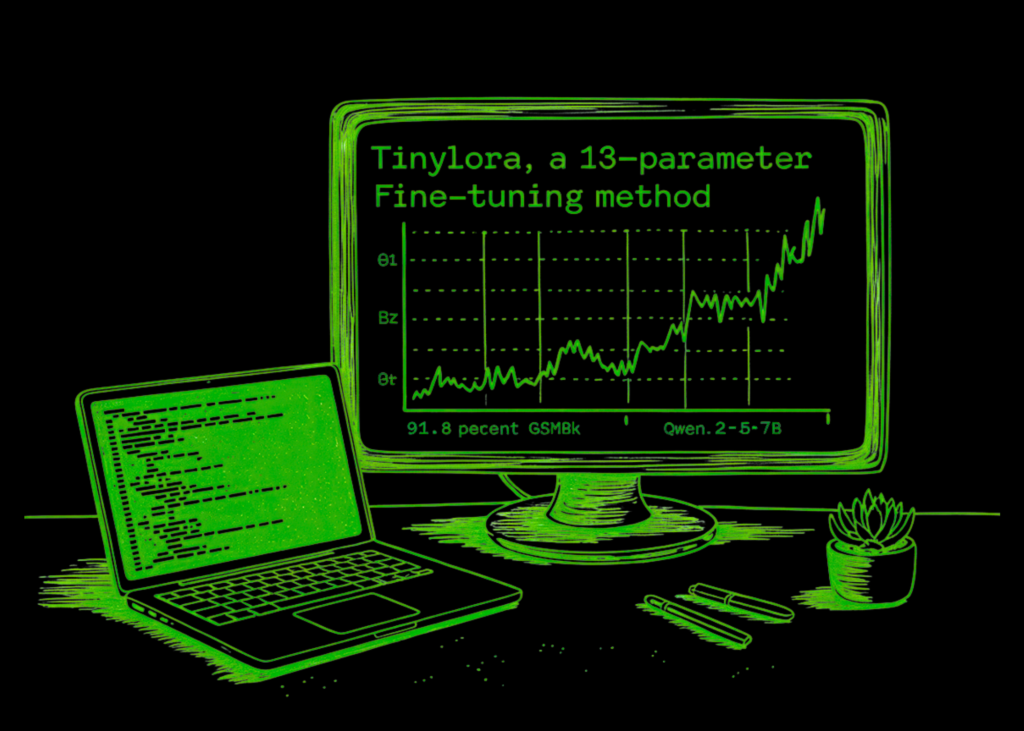
This AI Paper Introduces TinyLoRA, A 13-Parameter Fine-Tuning Method That Reaches 91.8 Percent GSM8K on Qwen2.5-7B
Source: MarkTechPost Researchers from FAIR at Meta, Cornell University, and Carnegie Mellon University have demonstrated that large language...

Yann LeCun’s New LeWorldModel (LeWM) Research Targets JEPA Collapse in Pixel-Based Predictive World Modeling
Source: MarkTechPost World Models (WMs) are a central framework for developing agents that reason and plan in a...
Meta AI’s New Hyperagents Don’t Just Solve Tasks—They Rewrite the Rules of How They Learn
Source: MarkTechPost The dream of recursive self-improvement in AI—where a system doesn’t just get better at a task,...

Luma Labs Launches Uni-1: The Autoregressive Transformer Model that Reasons through Intentions Before Generating Images
Source: MarkTechPost In the field of generative AI media, the industry is transitioning from purely probabilistic pixel synthesis...
How BM25 and RAG Retrieve Information Differently?
Source: MarkTechPost When you type a query into a search engine, something has to decide which documents are...
Implementing Deep Q-Learning (DQN) from Scratch Using RLax JAX Haiku and Optax to Train a CartPole Reinforcement Learning Agent
Source: MarkTechPost In this tutorial, we implement a reinforcement learning agent using RLax, a research-oriented library developed by...

Meet GitAgent: The Docker for AI Agents that is Finally Solving the Fragmentation between LangChain, AutoGen, and Claude Code
Source: MarkTechPost The current state of AI agent development is characterized by significant architectural fragmentation. Software devs building...
A Coding Implementation for Building and Analyzing Crystal Structures Using Pymatgen for Symmetry Analysis, Phase Diagrams, Surface Generation, and Materials Project Integration
Source: MarkTechPost In this tutorial, we explore the capabilities of the pymatgen library for computational materials science using...