
Source: MarkTechPost
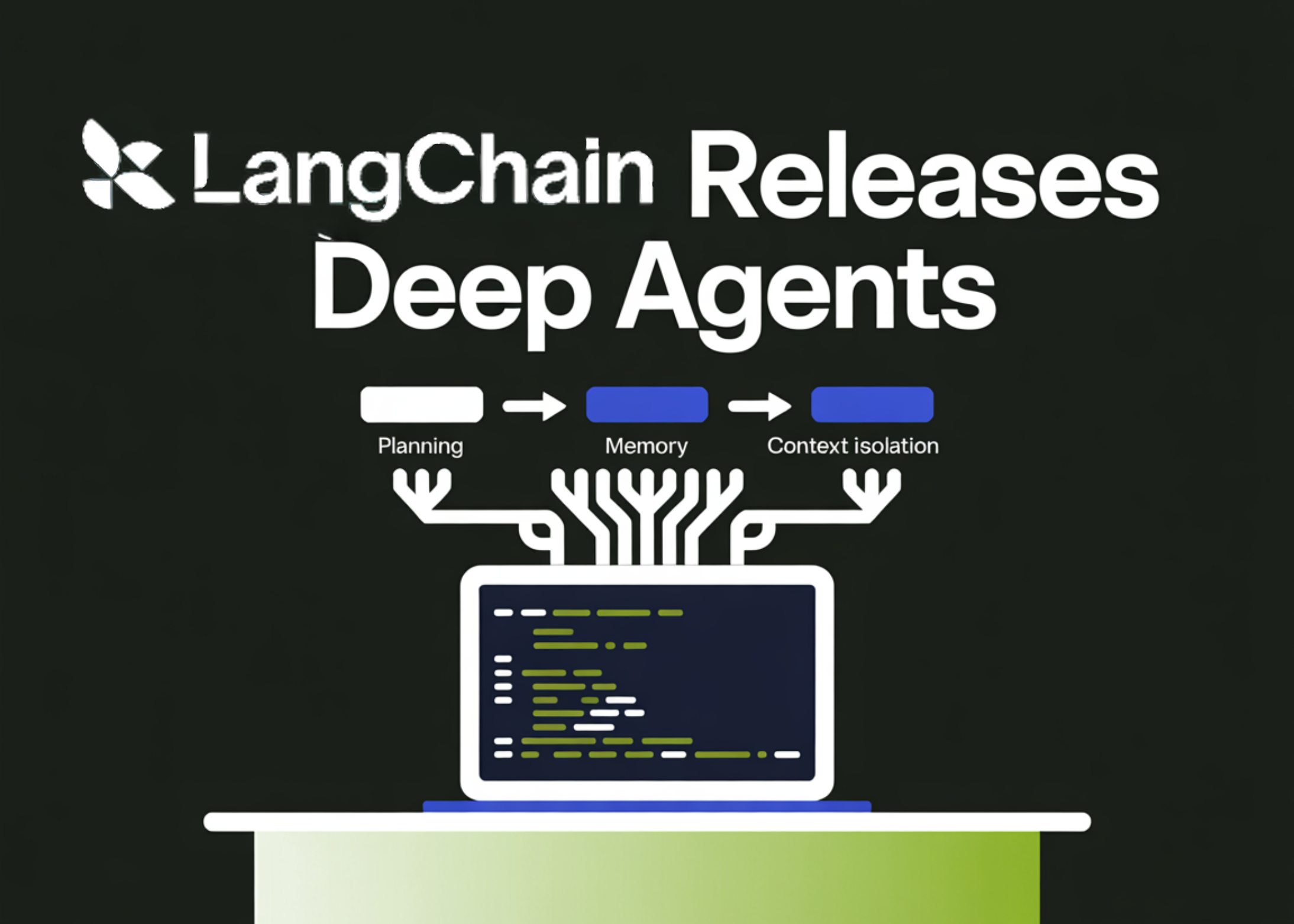
Most LLM agents work well for short tool-calling loops but start to break down when the task becomes multi-step, stateful, and artifact-heavy. LangChain’s Deep Agents is designed for that gap. The project is described by LangChain as an ‘agent harness‘: a standalone library built on top of LangChain’s agent building blocks and powered by the LangGraph runtime for durable execution, streaming, and human-in-the-loop workflows.
The important point is that Deep Agents does not introduce a new reasoning model or a new runtime separate from LangGraph. Instead, it packages a set of defaults and built-in tools around the standard tool-calling loop. LangChain team positions it as the easier starting point for developers who need agents that can plan, manage large context, delegate subtasks, and persist information across conversations, while still keeping the option to move to simpler LangChain agents or custom LangGraph workflows when needed.
What Deep Agents Includes by Default
The Deep Agents GitHub repository lists the core components directly. These include a planning tool called write_todos, filesystem tools such as read_file, write_file, edit_file, ls, glob, and grep, shell access through execute with sandboxing, the task tool for spawning subagents, and built-in context management features such as auto-summarization and saving large outputs to files.
That framing matters because many agent systems leave planning, intermediate storage, and subtask delegation to the application developer. Deep Agents moves those pieces into the default runtime.
Planning and Task Decomposition
Deep Agents includes a built-in write_todos tool for planning and task decomposition. The purpose is explicit: the agent can break a complex task into discrete steps, track progress, and update the plan as new information appears.
Without a planning layer, the model tends to improvise each step from the current prompt. With write_todos, the workflow becomes more structured, which is more useful for research tasks, coding sessions, or analysis jobs that unfold over several steps.
Filesystem-Based Context Management
A second core feature is the use of filesystem tools for context management. These tools allow the agent to offload large context into storage rather than keeping everything inside the active prompt window. LangChain team explicitly notes that this helps prevent context window overflow and supports variable-length tool results.
This is a more concrete design choice than vague claims about ‘memory.’ The agent can write notes, generated code, intermediate reports, or search outputs into files and retrieve them later. That makes the system more suitable for longer tasks where the output itself becomes part of the working state.
Deep Agents also supports multiple backend types for this virtual filesystem. The customization docs list StateBackend, FilesystemBackend, LocalShellBackend, StoreBackend, and CompositeBackend. By default, the system uses StateBackend, which stores an ephemeral filesystem in LangGraph state for a single thread.
Subagents and Context Isolation
Deep Agents also includes a built-in task tool for subagent spawning. This tool allows the main agent to create specialized subagents for context isolation, keeping the main thread cleaner while letting the system go deeper on specific subtasks.
This is one of the cleaner answers to a common failure mode in agent systems. Once a single thread accumulates too many objectives, tool outputs, and temporary decisions, model quality often drops. Splitting work into subagents reduces that overload and makes the orchestration path easier to debug.
Long-Term Memory and LangGraph Integration
The Deep Agents GitHub repository also describe long-term memory as a built-in capability. Deep Agents can be extended with persistent memory across threads using LangGraph’s Memory Store, allowing the agent to save and retrieve information from previous conversations.
On the implementation side, Deep Agents stays fully inside the LangGraph execution model. The customization docs specify that create_deep_agent(...) returns a CompiledStateGraph. The resulting graph can be used with standard LangGraph features such as streaming, Studio, and checkpointers.
Deep Agents is not a parallel abstraction layer that blocks access to runtime features; it is a prebuilt graph with defaults.
Deployment Details
For deployment, the official quickstart shows a minimal Python setup: install deepagents plus a search provider such as tavily-python, export your model API key and search API key, define a search tool, and then create the agent with create_deep_agent(...) using a tool-calling model. The docs note that Deep Agents requires tool calling support, and the example workflow is to initialize the agent with your tools and system_prompt, then run it with agent.invoke(...). LangChain team also points developers toward LangGraph deployment options for production, which fits because Deep Agents runs on the LangGraph runtime and supports built-in streaming for observing execution.
# pip install -qU deepagents from deepagents import create_deep_agent def get_weather(city: str) -> str: """Get weather for a given city.""" return f"It's always sunny in {city}!" agent = create_deep_agent( tools=[get_weather], system_prompt="You are a helpful assistant", ) # Run the agent agent.invoke( {"messages": [{"role": "user", "content": "what is the weather in sf"}]} )Key Takeaways
- Deep Agents is an agent harness built on LangChain and the LangGraph runtime.
- It includes built-in planning through the
write_todostool for multi-step task decomposition. - It uses filesystem tools to manage large context and reduce prompt-window pressure.
- It can spawn subagents with isolated context using the built-in
tasktool. - It supports persistent memory across threads through LangGraph’s Memory Store.
Check out Repo and Docs. Also, feel free to follow us on Twitter and don’t forget to join our 120k+ ML SubReddit and Subscribe to our Newsletter. Wait! are you on telegram? now you can join us on telegram as well.

Michal Sutter
Michal Sutter is a data science professional with a Master of Science in Data Science from the University of Padova. With a solid foundation in statistical analysis, machine learning, and data engineering, Michal excels at transforming complex datasets into actionable insights.