
Source: Unite.AI
A factory small enough to fit inside three shipping containers sounds like a logistics idea. For Stockholm startup 120ft, the harder problem is teaching robots to switch between products without rebuilding the production process each time.
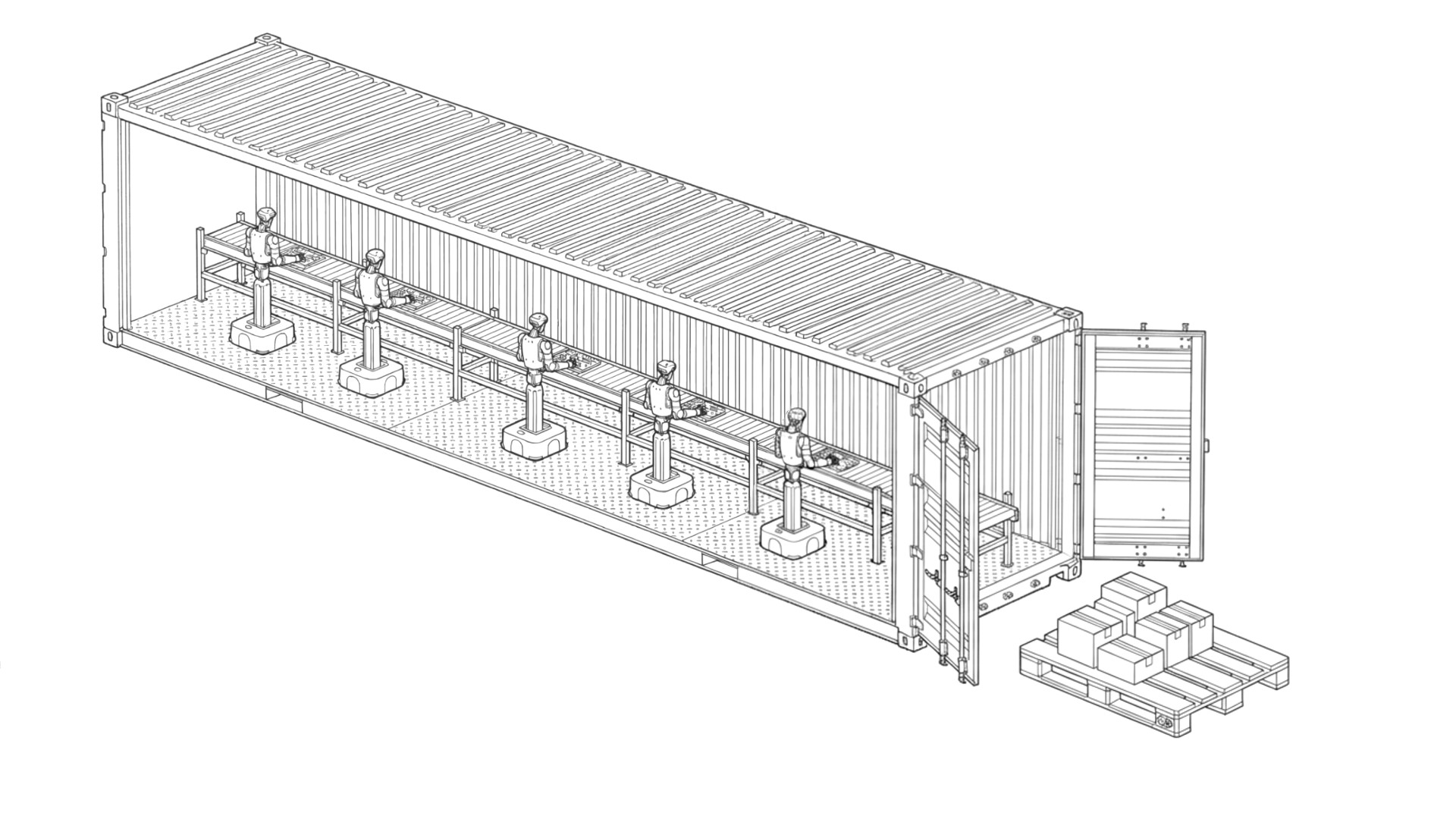
The company is emerging from stealth with a €576,000 angel round to develop autonomous microfactories staffed by humanoid robots. Its proposed model brings preparation, assembly, inspection and packing into three 40-foot containers, with software coordinating the work. The company would own and operate the factories, while brands pay for finished products.
The funding supports further development of its software and factory infrastructure as it moves toward commercial production. That distinction matters: this is an early manufacturing venture outlining a route to deployment, rather than announcing a mature network of autonomous factories.
A Shared Factory for Smaller Production Runs
120ft is targeting a difficult part of manufacturing economics. Smaller consumer brands often have to commit to large orders well before they know how much demand a product will generate. Dedicated production equipment, distant assembly facilities and long replenishment cycles can make experimenting with a new design expensive.
The startup’s answer is shared manufacturing capacity closer to customers. Multiple brands would use the same factory infrastructure, paying per finished unit rather than purchasing robots or commissioning their own production lines. Initial applications include small appliances, consumer electronics and other design-led consumer products.
Brands would keep their existing component suppliers and send parts to a 120ft facility for assembly. The model therefore localizes a portion of production; it does not eliminate the international supply chains behind components. Its value would depend on whether flexible final assembly can reduce the cost and risk of smaller batches enough to compensate for local operating expenses.
The name describes the format: three 40-foot containers add up to 120 feet. Standardizing the physical footprint could make deployment more repeatable, although a container layout alone does not establish factory throughput, safety performance or unit economics.
Turning Product Designs Into Robot Work
The technology starts before a robot picks up a part. According to 120ft, its workflow converts product designs, parts lists and quality requirements into digital manufacturing instructions. It then simulates the production line to identify missing information and potential bottlenecks before physical assembly begins.
That is a meaningful distinction from automating an isolated motion. A robot may be able to insert a component, but a production system must also ensure the component is available, positioned correctly and checked afterward. If a step fails, the system needs a way to recover without letting an incomplete or defective product move forward.
120ft says its proprietary orchestration software coordinates robots, tooling, parts preparation and quality checks, including handling failed tasks. Assembly instructions and production data are retained so successful work can be reused in subsequent runs.
Simulation has become an important development tool in robotics more broadly. Platforms such as NVIDIA Isaac Sim let developers build virtual environments, test robot behavior and generate synthetic data before deployment. Such tools can expose problems earlier and make experiments repeatable. 120ft has not disclosed the specific simulation platform or robot models it uses, so its announcement should not be read as confirmation of an NVIDIA software or hardware integration.
The broader challenge, explored in Unite.AI’s coverage of the relationship between robotics data, models and manufacturing, is translating learned behavior into reliable physical work. Repeating a successful demonstration is only one part of that task. Real production also introduces variation in parts, positioning, friction and wear.
What the Seven-Hour Learning Claim Measures
120ft reports that the time required to teach one end-to-end assembly skill has fallen from seven weeks in 2025 to seven hours in 2026. It is targeting seven minutes in 2027.
Those figures describe skill teaching, not the time needed to manufacture a product. They also do not establish how quickly an entire factory can change over to a new product, which can involve tooling, fixtures, inspection procedures and material handling beyond the individual learned skill.
The company describes a lamp assembly demonstration involving a cylinder lock, threading a bulb fitting and a functional test. This gives a more concrete picture of its intended workload than a general claim about humanoid intelligence: handling components, completing assembly operations and checking the result.
The release does not provide a detailed testing protocol, success rate, range of products tested or frequency of human intervention. The reported learning improvement is therefore a company claim about development progress, not an independently validated measure of commercial reliability. The seven-minute figure remains a future target.
For customers, the eventual test will be practical. How many acceptable products can a facility deliver per shift? How often does work stop? How much does each finished unit cost once supervision, maintenance and rejected parts are included? Those measures will determine whether faster skill acquisition produces a better manufacturing service.
Hardware Experience Behind the Venture
Founder and CEO Martin Willers established 120ft in 2025. He previously co-founded repairable audio brand Transparent and built hardware design firm People People, which was sold to EY Doberman. The new company’s focus on smaller consumer brands reflects manufacturing problems he encountered across those businesses.
The round includes 22 angel investors. Named participants include Ted Persson, partner and co-head of the Scaleup Europe Fund at EQT; Sophia Bendz, a partner at Cherry Ventures and former Spotify global marketing director; and Fashwell co-founder Matthias Dantone. The announcement also names Sam Baker of Planet A. The affiliations of individual angel investors should not be confused with an announcement that each of their firms invested.
Beyond new product assembly, 120ft sees possibilities in repair, upgrades and remanufacturing. Those applications would demand additional flexibility because returned products can arrive in different conditions, rather than as uniform sets of new components.
The Manufacturing Bet Behind the Robots
120ft’s central bet is that robotics and reusable production software can make shared, smaller-scale assembly commercially attractive. Humanoid robots are the visible part of the proposal. The less visible work is connecting product information, task execution and quality control into a process that can reliably deliver finished goods.
If that approach works, smaller brands could gain another way to test demand and replenish products without taking on an entire factory. The next milestone is demonstrating that the containerized system can sustain dependable production across changing jobs. The angel round funds the effort to turn that proposition into an operating business.