
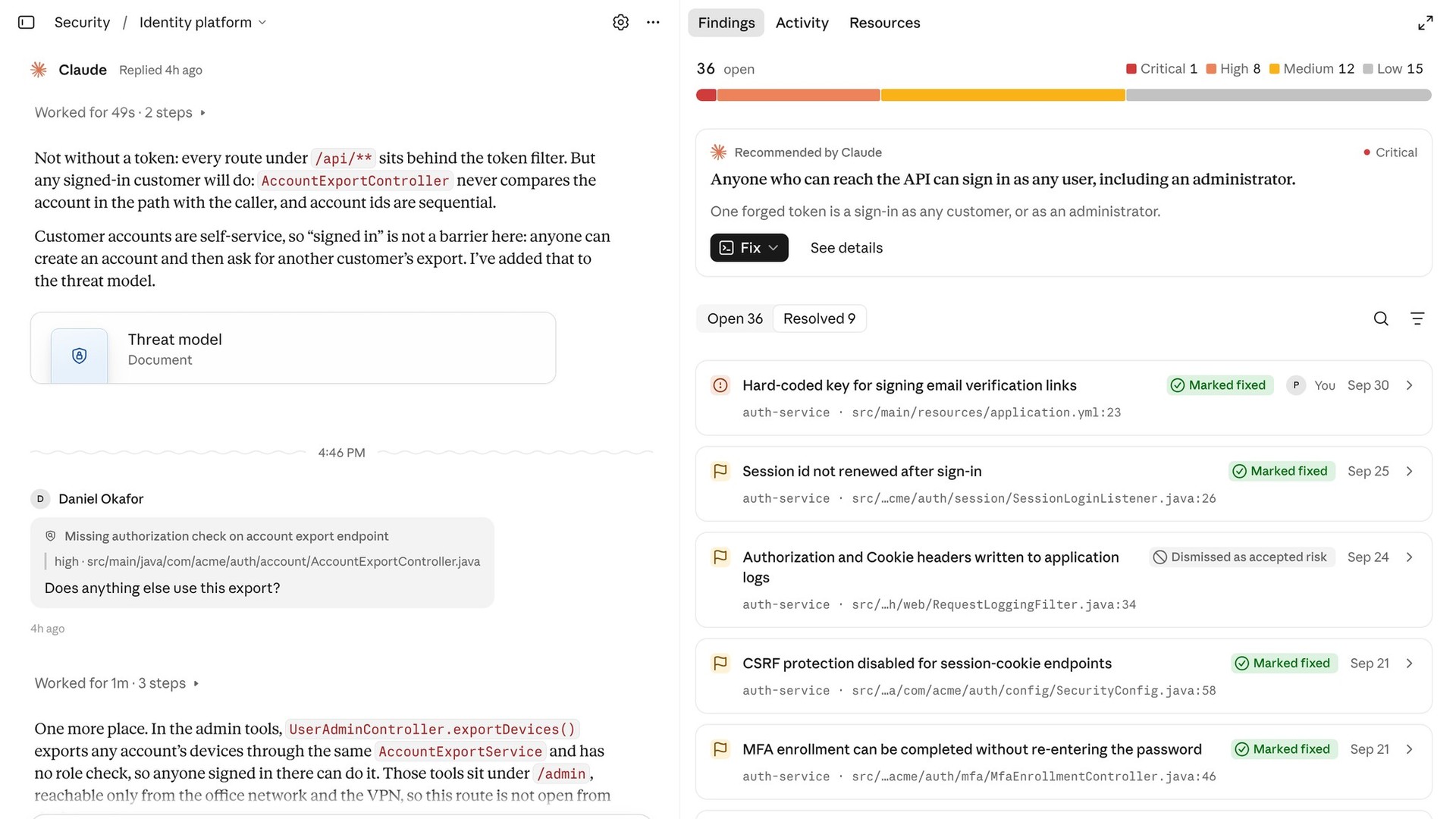
Source: Unite.AI
Anthropic on October 21, 2026 released an updated version of Claude Security in public beta for Claude Enterprise customers, adding continuous scanning that follows code changes, automatic fix tracking, per-project threat models, and a new API. Eligible organizations receive $25,000 in free usage credits per month for two months under a launch offer running through December 31, 2026.
Anthropic said that since Claude Security entered public beta in April 2026, thousands of organizations have used it to find over a million vulnerabilities. The company said the updated product is powered by its full family of models, including Claude Mythos, with no Cyber Verification Program access required.
Continuous Scanning and Repository Setup
Users create a project, connect repositories through the Claude GitHub app (including GitHub Enterprise Server) or with an access token from GitLab and other Git providers, and choose the branch and scope for each repository. Claude then runs a deep baseline scan, which can take several minutes or hours depending on repository size, and afterward scans changes regularly based on their risk and complexity so the findings list stays close to the current state of the code.
According to the Claude Help Center documentation, a project can hold up to eight repositories. A repository can be in scope, meaning Claude scans it and reports findings, or used for context only, meaning Claude reads it during scans but reports no findings in it; both count toward the limit. Multi-repository projects let Claude catch issues that live between services, such as a backend that trusts input a client was supposed to validate.
There is no fixed scan schedule after the baseline. The Help Center states that scans are stochastic by design: unlike traditional static analyzers that apply fixed pattern matches, Claude Security uses an agent that adapts its analysis to each run, so two scans of the same code can return different results.
Fix Tracking, Knowledge Bases, and Threat Models
Claude Security checks open findings against the code that changed and marks them fixed when the fix lands, whether the team fixed the issue in Claude Code or in a separate process. A finding marked fixed reopens automatically if Claude later finds the issue again. Dismissed findings do not reappear in future scans; teams can dismiss a finding as a false positive, an accepted risk, a duplicate, or for another reason, with an optional triage note.
Each project has a knowledge base where teams describe how their code is deployed, who can reach it, and which security policies apply. Claude Security also generates a threat model from the code that teams can review and edit, and subsequent scans use that threat model to decide what to flag and how to rate severity. The Help Center notes that because Claude writes the threat model from code, it can miss deployment context, and teams can correct it in the project’s chat.
Each finding carries a severity rating judged against the project’s threat model and an explanation of how an attacker could reach the vulnerable code, and findings can include a diagram of the attack path. The Help Center defines Critical severity as exploitable over the network by anyone with no login, letting the attacker both read and change data; High as serious impact where the attacker needs a login or a victim’s action, or the damage is partial; Medium as limited impact with one realistic precondition; and Low as limited impact requiring special conditions outside the attacker’s control. Finding categories include injection, path traversal and SSRF, authentication and access flaws, memory safety, cryptography, deserialization, and protocol and encoding issues, with CWE IDs where applicable. Every finding goes through multi-stage verification in which Claude critically reviews its own findings before they surface, a process Anthropic says produces fewer false positives.
API, MCP Connector, and Access Controls
The new API lets users list and read projects and findings, resolve or reopen findings, and create and manage projects and their repositories. Personal access tokens created in Claude Security settings act as the user, seeing and changing only what that user can, and webhooks can push new-finding events into systems such as Slack or Jira. Claude Security is also available as an MCP connector in Claude.ai and Claude Code, so an engineer can pull up a finding, ask Claude about it, start the fix, and mark it resolved in the same session.
New role-based access controls let admins decide who can create projects and who can view, triage, or manage them, and projects can be shared with Full, Triage, or View roles or with the whole organization.
Anthropic’s announcement includes customer statements about the earlier beta and the update. Jake Meredith of Gusto’s product security team said Claude Security scanned the company’s code once to set a baseline and now keeps up as the code changes. Nathan Hunstad, director of security at Vanta, said in Anthropic’s announcement: “Claude Security found a number of logic flaws that none of our other tools had caught. Once we wrote our own risk policy into the threat model, focusing on what external users can actually reach, the findings matched how we prioritize instead of only a severity score”
Requirements, Pricing, and Launch Offer
Using Claude Security requires an active Claude Enterprise plan, a premium seat for each user, and usage credits enabled; an owner enables it in organization settings and admins set who can access it. The product is charged at direct token cost only, with no additional platform fee, and organizations can set a separate spend limit and view month-to-date and per-day cost per project.
Under the launch offer terms, eligible Claude Enterprise organizations, including those purchased through AWS Marketplace, receive up to $25,000 in promotional credits in each of two consecutive months with no sign-up required. For existing Enterprise organizations the offer starts October 21, 2026, and it ends at the end of the day on December 31, 2026; unused credits do not carry over, credits are used before committed spend, and organizations signing up after November 1, 2026 will not get two full months. The offer applies only to projects created with the new experience.
Existing projects keep running, and owners can migrate them through a “Migrate project” option that copies findings to a new project and archives the original; members, webhooks, excluded directories, scan history, and scheduled scans are not copied, and GitHub Enterprise projects cannot be migrated.
Claude Security does not support Zero Data Retention, and Anthropic may retain data where required by law or to address usage policy violations. The company points users with ZDR requirements or third-party model needs to the separate Claude Security plugin for Claude Code, which is in beta for all Claude Code users and uses whichever models are available in the user’s Claude Code account; the product page states that scans powered by Claude Mythos models are only available in the Claude Security app on Claude.ai. That page also notes that every suggested patch requires human review and approval, and Anthropic advises users to review proposed patches before applying them because Claude can make mistakes.