
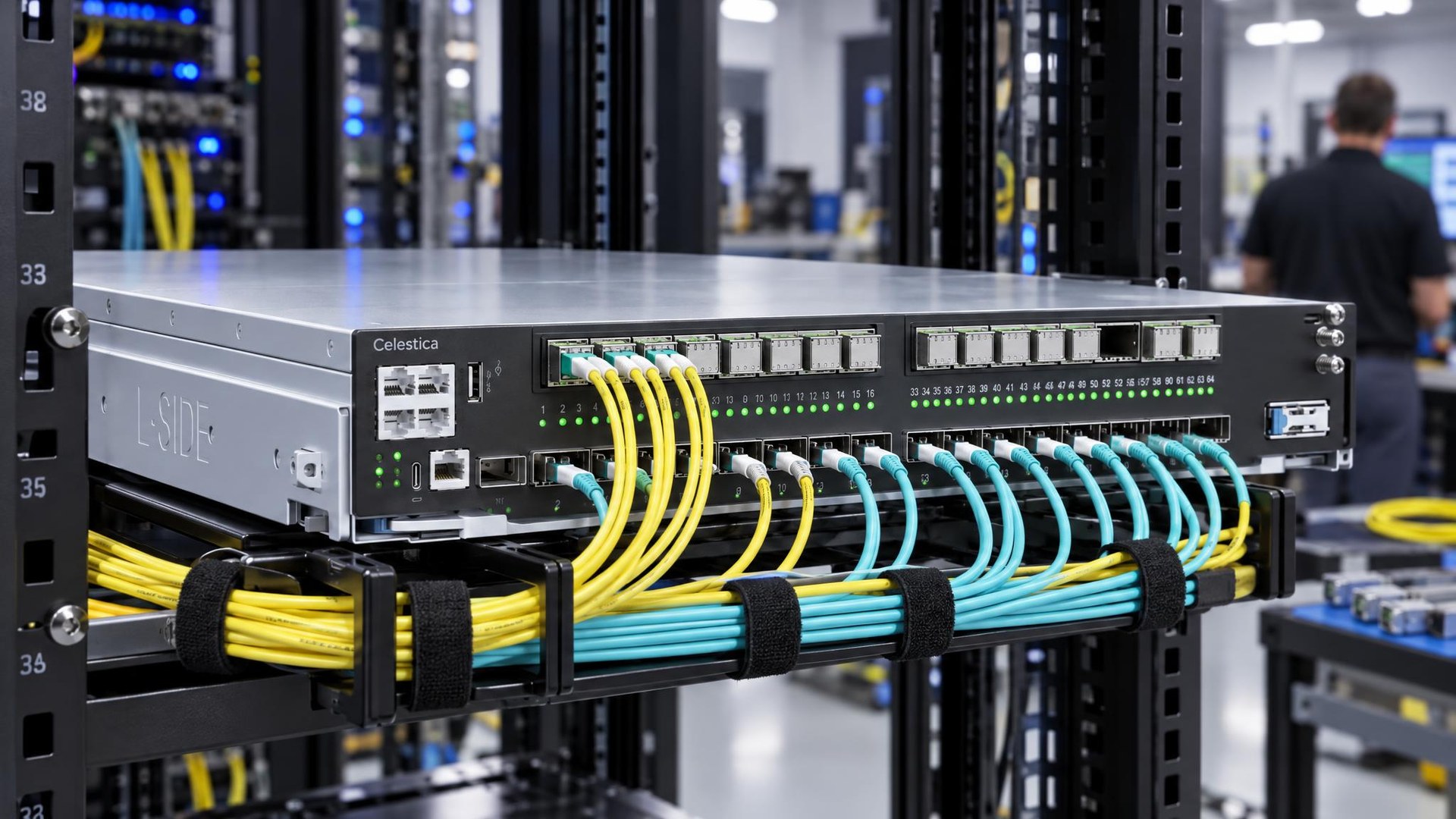
Source: Unite.AI
Celestica introduced the DS6005, a fully liquid-cooled data center switch that delivers up to 102.4Tbps of capacity through co-packaged optics, in a company announcement dated October 12, 2026. The system is built on Broadcom’s Tomahawk 6 – Davisson switch chip, and Celestica is showcasing it at the 2026 OCP Global Summit in San Jose, which runs October 12–15, 2026.
The Toronto-based company described the DS6005 as a co-packaged optics (CPO) switching system designed around the bandwidth density, power, latency, and reach requirements of next-generation AI data center networks. Celestica said the switch is purpose-built for AI and machine learning scale-up and scale-out networking, and that it reduces power consumption, lowers latency, and improves cluster efficiency and reliability in next-generation AI clusters.
Gavin Cato, Celestica’s senior vice president and general manager of portfolio solutions and AI platform engineering, said AI infrastructure is driving demand for bandwidth while power, thermal management, latency, and reach become increasingly important constraints. “The DS6005 brings co-packaged optics, liquid cooling, field-replaceable external laser modules, and CPO-aware software management together in a compact platform designed to help customers build scalable and power-efficient AI fabrics,” Cato said.
DS6005 Hardware and Design
The DS6005 places its optical engines directly on the switch ASIC package instead of using conventional front-panel pluggable optics. Celestica said the co-packaged layout is intended to help data center operators optimize bandwidth density, reduce latency, and improve power efficiency. The company listed 64 ports of 1.6TbE providing the system’s 102.4Tbps switching capacity, and said the fully liquid-cooled 1.5OU enclosure, designed for OCP ORv3 racks, improves temperature stability and reliability while increasing overall rack density. The switch also supports SONiC, which Celestica said enables faster time to production on a proven, open architecture.
The DS6005 product page lists an AMD Ryzen x86 CPU alongside the Broadcom TH6-Davisson chip. The 64 optical interconnects run through 16x 4x MMC-16 connectors, and the system also carries one 100GbE QSFP28 port, RJ45 console and out-of-band GbE management ports, one USB 3.0 Type A port, one USB-C console port, and 16 ELSFP interfaces for external laser modules. The unit complies with the ORv3-HPR rack specification.
On the product page, Celestica said the switch reduces link power consumption, delivers ultra-low latency, and reduces latency relative to retimed optics. The page names AI and machine learning scale-up and scale-out networks, high-performance computing, frontier cloud and enterprise domain AI models, and hyperscale cloud infrastructure as the deployment types the system is optimized for.
Broadcom’s Tomahawk 6 – Davisson Silicon
Broadcom announced on October 8, 2025 that it was shipping Tomahawk 6 – Davisson, its third-generation CPO Ethernet switch, which it described as the industry’s first to deliver 102.4Tbps of optically enabled switching capacity. For the BCM78919 device, Broadcom listed 16 Davisson DR optical engines of 6.4Tbps each, 200Gbps of bandwidth per link, field-replaceable ELSFP laser modules, and support for scale-up clusters of 512 XPUs as well as over 100,000 XPUs in two-tier networks at 200Gbps per link. According to Broadcom, the chip complies with IEEE 802.3 and interoperates with existing 400G and 800G standards.
Broadcom said TH6-Davisson heterogeneously integrates optical engines based on TSMC’s COUPE technology with advanced substrate-level multi-chip packaging, and reported a 70% reduction in optical interconnect power consumption, a level it described as more than 3.5 times lower than traditional pluggable solutions. Cato provided a supporting statement in that 2025 announcement, saying the chip’s optical integration, power efficiency, and performance aligned with Celestica’s strategy for next-generation AI infrastructure and workload deployments.
Supporting Statements and Summit Showcase
Manish Mehta, vice president of marketing and operations in Broadcom’s Optical Systems Division, said moving co-packaged optics from an advanced architecture to a production-ready system requires collaboration across silicon, optical engines, packaging, thermal design, manufacturing, and system integration. Mehta said Celestica’s system engineering and platform execution helped translate Broadcom’s technology into a platform designed for high-density AI fabrics.
Sameh Boujelbene, vice president of research at Dell’Oro Group, said AI networking is shifting the constraint from compute to the physical infrastructure around it, where power, density, reach, and deployment complexity increasingly matter. Boujelbene described co-packaged optics as one of the industry’s important paths to address those challenges, and said pluggable, near-package, and co-packaged approaches will continue to coexist as the ecosystem matures.
Alan Weckel, founder and technology analyst at 650 Group, said co-packaged optics is moving from an industry theme toward production for AI networking, with an important near-term opportunity in controlled, high-density scale-out fabrics. Cliff Grossner, chief innovation officer of the Open Compute Project Foundation, said open collaboration across silicon photonics, hardware, software, and management is essential to building scalable, interoperable AI fabrics that can be deployed and supported at scale.
Celestica said it will exhibit the DS6005 in booth C2 at the 2026 OCP Global Summit, which the Open Compute Project Foundation is holding October 12–15, 2026 in San Jose, California. The foundation’s event page states that the 2026 summit is sold out, that registration is closed, and that onsite registration will not be offered. Celestica directed readers to its event landing page for more information about its participation at the summit, which concludes October 15, 2026.