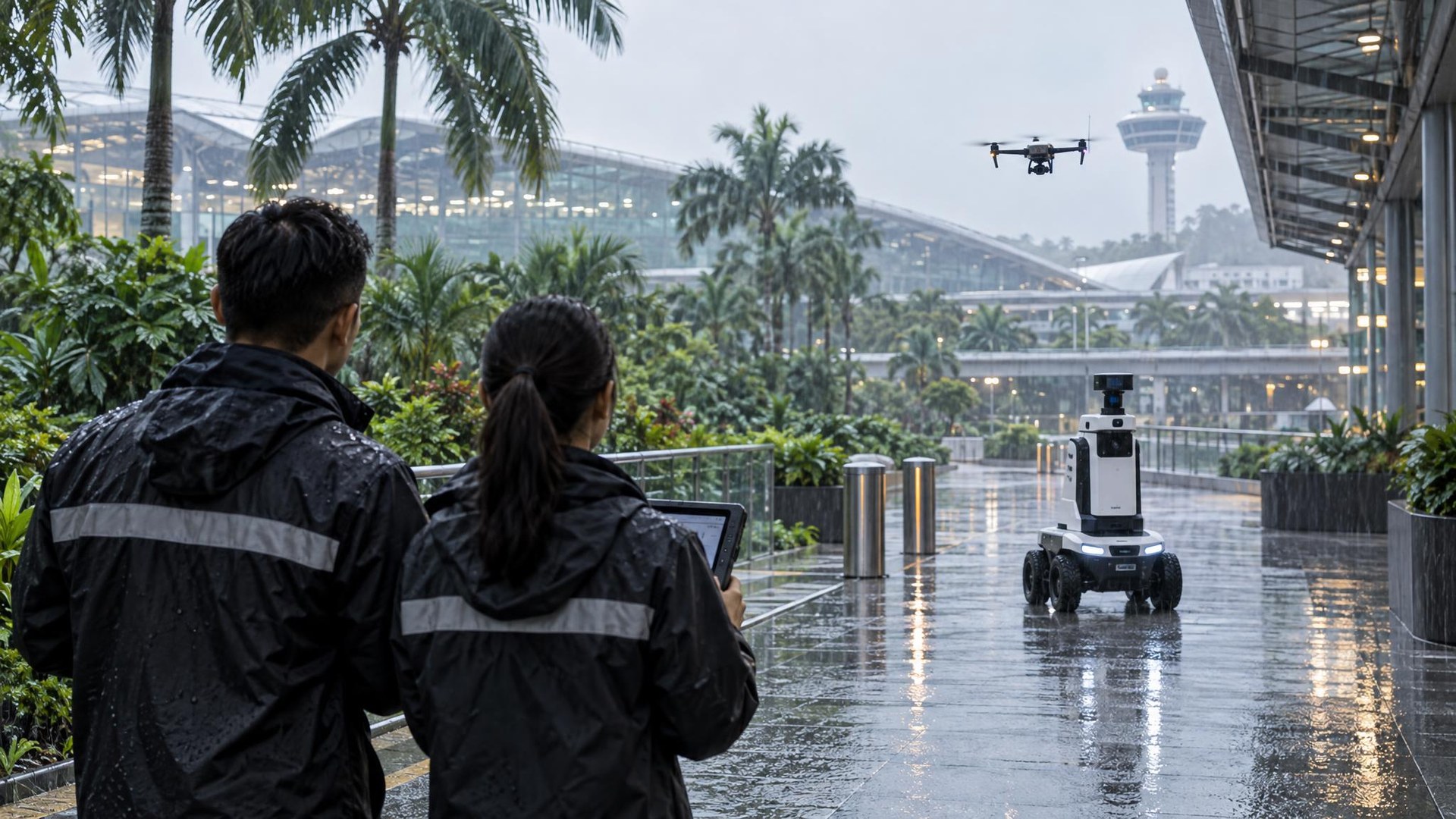
Source: Unite.AI
Certis and the Singapore University of Technology and Design (SUTD) announced a three-year memorandum of understanding on November 25, 2026 to jointly develop and test Physical AI, robotics and drone technologies in live security and facilities operations. The MOU also covers engineering talent development and ambitions for commercial deployment.
The agreement pairs SUTD’s research in autonomous systems and robotics with Certis’s technology integration and deployment experience across security, facilities management, aviation and the built environment. It builds on the organizations’ first partnership in 2024, which focused on raising AI literacy among security professionals.
Certis reports that it has deployed robots in live operations since 2019 and operates more than 60 robots across 30 Singapore sites for security patrols, cleaning and concierge services. Mozart, its proprietary AI orchestration platform, brings autonomous systems and frontline teams together.
Tropical Conditions Shape the Research Agenda
Joint research will cover autonomous navigation in complex environments, sensor fusion and perception systems, edge computing, human-robot teaming and fleet management. The partners will also adapt autonomous systems for tropical urban environments and develop tailored drone and unmanned-system technologies for security, inspection and facilities operations.
Heavy rain, heat and humidity can degrade sensor performance and battery life, according to the partners, making local testing important before systems are deployed at scale. Environmental adaptation consequently sits alongside autonomy and fleet coordination in the planned development work.
Field Trials Precede the First Projects
The partners will set up a framework for demonstrations, trials and field validation. Solutions may be tested at SUTD facilities, including its DIVE | Physical AI facility, and in Certis’s operational environments, allowing capabilities to be assessed against real conditions and refined before wider deployment.
“The challenge is translating advances in technology into solutions that can operate reliably and at scale,” said Raahul Kumar, Certis’s chief executive for international and robotics and chief strategy officer.
The partners expect the first joint projects to begin in the first half of 2027, initially addressing autonomous aviation security screening operations such as loading capabilities and unattended baggage handling systems.
Training and Commercial Deployment
The MOU provides for SUTD students to gain practical experience through internships, capstone projects, research attachments and field deployments with Certis. Structured internship-to-employment pathways and work-study arrangements remain to be developed. Certis will contribute operational expertise through guest lectures, workshops, industry challenges, case studies and mentoring.
Beyond research and education, the partners plan to engage industry and government stakeholders to identify pilot deployment opportunities. Their stated ambition is to turn jointly developed technologies into commercially viable solutions that can be deployed at scale.
For both partners, the practical test is whether the 2027 aviation-security work can turn that combination of research, field validation and training into systems ready for broader operational use.