
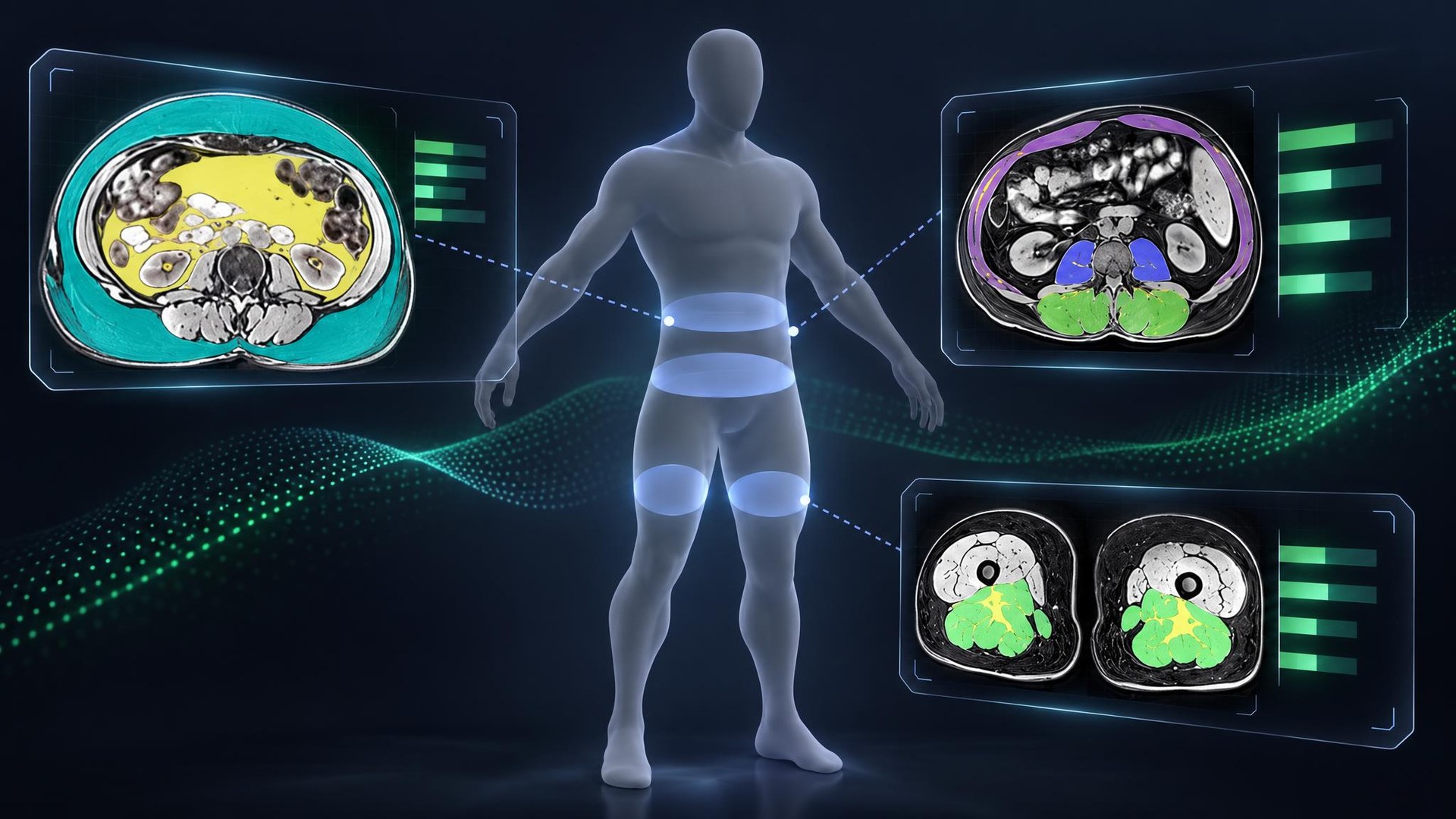
Source: Unite.AI
AIRS Medical said on October 5, 2026, that the U.S. Food and Drug Administration granted 510(k) clearance for SwiftSight Body Composition, its AI-powered quantitative MRI software, with SimonMed Imaging as the first customer to deploy it. The Chicago-datelined announcement said the clearance expands the company’s quantitative MRI platform into body composition analysis.
SwiftSight Body Composition uses AI-powered MRI analysis to quantify muscle and adipose tissue from MR images. According to the company, the software measures visceral and subcutaneous fat, abdominal and thigh muscle, muscle quality and bilateral muscle balance, and provides quantitative assessment of liver fat.
What SwiftSight Body Composition Measures
The product is built around an MRI scan of less than five minutes, followed by automated AI analysis. AIRS Medical says AI-driven segmentation quantifies the body composition measurements, which are benchmarked against age- and sex-matched reference populations. Results are compiled into a Body Composition Report that brings together quantitative measurements, percentile rankings and visual summaries in one standardized view.
The examination covers the abdomen, liver and thigh. Within those regions, the software evaluates core muscles including the abdominal wall, psoas and paraspinal muscles, as well as the quadriceps, hamstrings and adductors, with assessment of muscle proportion, quality and bilateral balance. Liver fat is quantified using proton density fat fraction (PDFF): AIRS Medical’s product documentation states that the software analyzes three regions of interest, calculates an average liver fat fraction and provides a visual color map alongside the quantitative result. Muscle quality is assessed through intramuscular fat infiltration, known as myosteatosis, where lower fat infiltration corresponds with higher muscle quality, according to the documentation.
The documentation also states that the company’s SwiftMR reconstruction software can be incorporated to support faster acquisition where appropriate, and that repeat assessments can be used to evaluate changes in fat distribution, muscle composition, muscle quality, balance and liver fat over time.
Positioning for Imaging Organizations
AIRS Medical says the sub-five-minute scan and automated scan-to-report workflow are designed to fit high-volume MRI operations, and that organizations can add the service without introducing a separate imaging modality or building a new manual analysis workflow. Because the analysis is automated, the company says, multi-site organizations can deploy the same quantitative capability across locations with a consistent approach to analysis and reporting.
“Body composition becomes more meaningful when people can track change over time, and that requires an exam that is fast and practical to repeat,” said Jina Park, Chief Strategy Officer at AIRS Medical. Park named preventive health, weight management and longevity as target uses and described the measurement as one people can return to over time.
The company also frames the clearance as a commercial opportunity for imaging providers, saying whole-body and preventive imaging, healthy-aging, weight-management and wellness programs can be extended with a quantitative service that creates a new revenue opportunity from MRI infrastructure already in operation. The product documentation additionally lists metabolic assessment and rehabilitation and performance among the program types the software can support. Because MRI does not use ionizing radiation, the company says SwiftSight can support repeat quantitative assessment over time; the documentation contrasts MRI with DEXA, which it characterizes as more limited in assessing visceral and intramuscular fat, and CT, which it describes as less suited to frequent repeat assessment because of radiation exposure.
“The next phase of MRI is not just better images, but standardized quantitative information that can scale across an imaging organization,” said Ajit Shankaranarayanan, PhD, Chief Product Officer at AIRS Medical. He described SwiftSight Body Composition as part of that shift and as a foundation for additional measurement capabilities across the SwiftSight platform.
Clearance History and Platform Roadmap
The clearance extends AIRS Medical’s quantitative MRI portfolio beyond brain imaging. FDA 510(k) records show the company’s SwiftSight-Brain software received a substantially equivalent decision on September 23, 2025, while its SwiftMR software received substantially equivalent decisions on October 27, 2023, March 26, 2026, and July 24, 2026, each through the traditional clearance pathway and each assigned to the agency’s radiology advisory committee.
According to the company’s September 30, 2026 platform update, SwiftSight-Brain is built on a normative database of 32,615 adults spanning ages 18 to 97, incorporating MRI data from Siemens Healthineers, GE Healthcare and Philips Healthcare scanners at both 1.5T and 3T. The update states that SwiftMR is FDA-cleared, CE-marked under the EU Medical Device Regulation, and approved by regulators including Korea’s MFDS and Japan’s PMDA across more than 40 countries.
The SwiftSight roadmap includes diffusion tensor imaging (DTI) planned for November 2026 and quantitative joint applications planned for 2027, the company said. Its research portfolio also includes spine, joint, and women’s and men’s health. AIRS Medical will showcase its latest SwiftMR and SwiftSight products at RSNA 2026 in Chicago from November 29 to December 2, 2026, at Booth #4921.