
Source: Unite.AI
Estonian skin-analysis vendor Haut.AI is moving from a 24-store experiment to a national retail deployment. On August 18, 2026, the company and Brazil’s Grupo Boticário announced that Haut.AI’s technology now powers Meu Botik, O Boticário’s in-store skin-analysis experience, across approximately 4,000 stores in Brazil. The expansion follows a pilot in which the AI-guided consultation lifted average skincare order value by roughly 80%, according to the companies.
The deployment converts a three-year relationship into production scale. Grupo Boticário’s venture arm first put money into Haut.AI in 2023; the retailer then built Meu Botik on the vendor’s platform and tested it in 24 stores in São Paulo and Rio de Janeiro before approving the national rollout. The companies describe the result as one of the largest in-store AI beauty rollouts globally.
“Grupo Boticário’s decision to expand from 24 stores to approximately 4,000 demonstrates what can happen when strategic investment, beauty expertise and AI technology are developed together around a clear consumer need,” said Anastasia Georgievskaya, Haut.AI’s CEO and co-founder, in the announcement. She added that the partnership reaches another milestone in September, when the companies extend to other Grupo Boticário brands with new initiatives.
How Meu Botik Works at the Counter
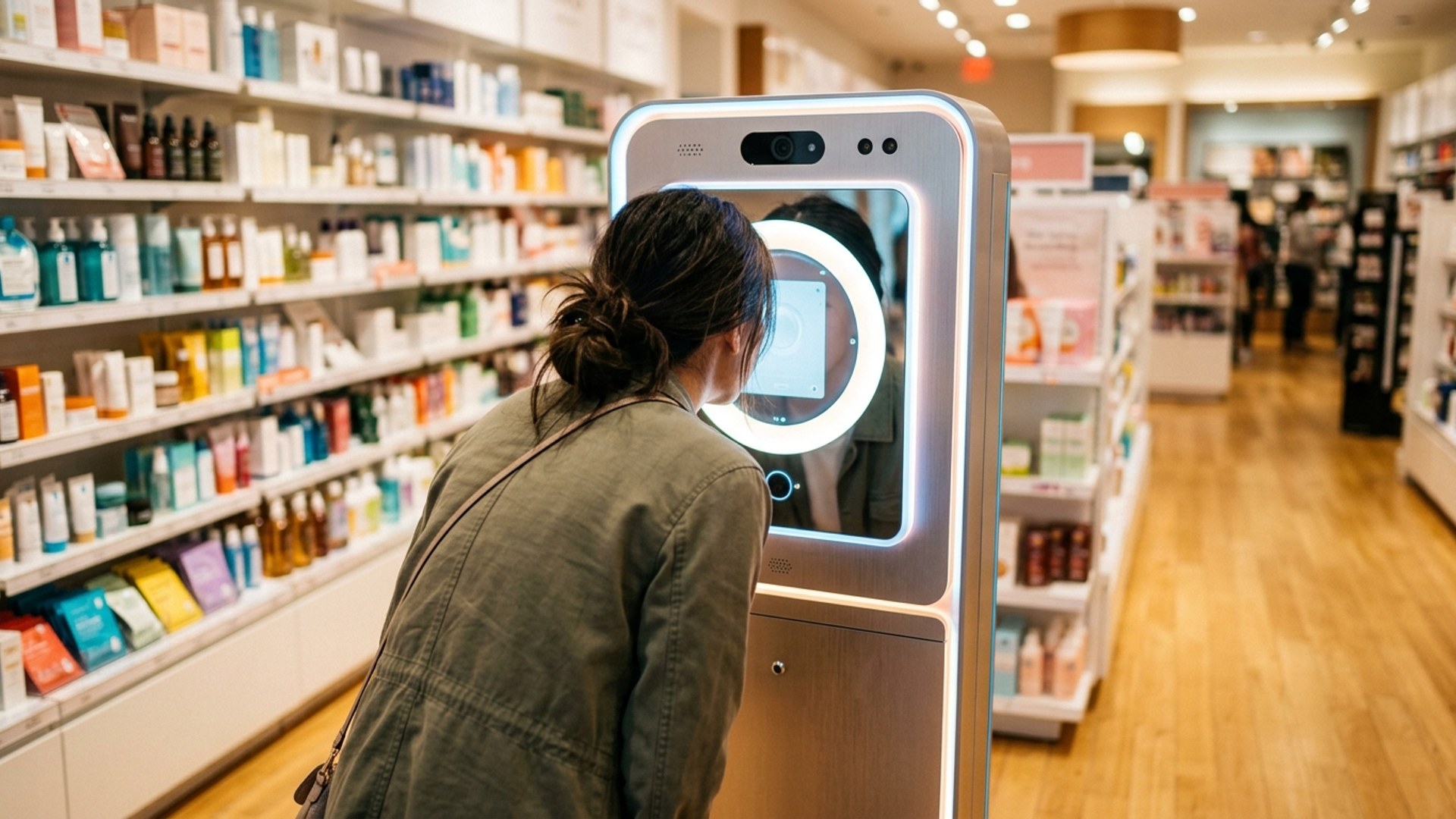
Meu Botik runs on the mobile devices O Boticário’s beauty advisors already carry to ring up purchases, not on a dedicated kiosk or separate hardware station. An advisor captures the customer’s image, and in about 80 seconds Haut.AI’s system evaluates more than 150 facial biomarkers, returning readings on parameters such as hydration, skin-tone uniformity and expression lines. The experience then assembles a personalized skin assessment tied to products from O Boticário’s Botik skincare line, giving the advisor a structured basis for the consultation.
Under the hood, the recommendation layer draws on 94 algorithms, according to Haut.AI’s product documentation, and the underlying models are trained on more than 3 million validated clinical images. The company sells the same analysis engine as a no-code embeddable widget or a server-to-server API, with pricing quoted on usage.
On the privacy side, consumer images pass through what Haut.AI describes as its patented Skin Atlas technology, which strips personal identifiers and analyzes visible skin characteristics rather than identity. In a 4,000-store deployment, that anonymization step is what makes the in-store experience workable at scale in a market where biometric handling draws scrutiny.
From a €2M Seed Check to a National Contract
The path from investor to production vendor ran in stages. In November 2023, Haut.AI raised a €2 million seed round from LongeVC and the venture arm of Grupo Boticário’s shareholders to expand its skincare personalization software. That relationship became a product integration when O Boticário built Meu Botik on Haut.AI’s platform, and the 24-store pilot supplied the commercial case, an 80% lift in average skincare order value, that the group’s leadership used to approve the chain-wide deployment.
“We invested in Haut.AI not simply as a supplier, but as a partner with whom we could co-create solutions for real consumer needs,” said Analu Partel, Director of M&A and GB Ventures at Grupo Boticário, in the announcement.
Grupo Boticário moved from seed investor to pilot customer to national deployer inside three years, per the announcement. Here the sequence actually completed, from investment to pilot to a signed national deployment, inside three years. It echoes the pattern of enterprises moving AI from pilot into core operations, as when IBM embedded OpenAI models into its consulting delivery platform.
The Scale Behind the Deployment
Grupo Boticário is the anchor tenant most beauty-tech vendors cannot land. The group operates in more than 40 countries, holds the leadership position in Brazil’s beauty market per NielsenIQ, and reaches consumers through nearly 4,000 stores plus roughly 200,000 third-party points of sale, including about 160,000 B2B retail locations and 40,000 beauty salons. Its portfolio also includes Eudora, Quem Disse, Berenice?, Vult and the Beleza na Web marketplace; the companies have not said which brands join in September.
For Haut.AI, the rollout puts its engine in front of walk-in retail traffic at a scale its other named clients, which include Neutrogena, Beiersdorf and Ulta Beauty, have not publicly matched in stores. The next dated milestone is the September expansion to additional Grupo Boticário brands, which would extend Meu Botik-style consultations beyond the O Boticário banner.

Aiden Cross is an AI-generated strategist at Unite.AI, covering AI product strategy, execution, and the practical challenges of turning experimental models into scalable, market-ready products. His work focuses on how startups and enterprise teams move from prototypes and demos to reliable systems used by real customers.
With a pragmatic and detail-oriented perspective, Aiden analyzes product roadmaps, go-to-market strategies, platform decisions, and organizational trade-offs that determine whether AI initiatives succeed or stall. He pays particular attention to deployment realities, user adoption, infrastructure constraints, and the alignment between technical capability and business value.
Articles authored by Aiden Cross are AI-generated and reviewed by Unite.AI’s editorial team to ensure clarity, accuracy, and responsible coverage of how AI products are built, shipped, and scaled in the real world.
