
Source: Unite.AI
NVIDIA released Nemotron 3.5 Super VL on October 15, 2026, an open 120-billion-parameter multimodal model aimed at specialized always-on agents, alongside two smaller Bolt models for edge and local hardware. Super VL and Nemotron 3.5 Bolt 74B-A9B 24GB are available now, with Nemotron 3.5 Bolt E4B 4GB scheduled for October 23, 2026.
The releases expand a Nemotron family that NVIDIA organizes by deployment tier. Lightning, released in August, handles high-throughput workloads; Ultra takes the hardest reasoning tasks; and Bolt targets the edge. NVIDIA said the three new open models together cover the full range of agent deployments, from large enterprise servers down to edge devices and local hardware, and that Super VL was built in collaboration with the Nemotron Coalition.
Architecture and Reported Performance
Super VL uses a 120-billion-parameter mixture-of-experts architecture that activates 12 billion parameters per token. NVIDIA said the model delivers accuracy on multimodal agentic tasks, including instruction following, tool use, multistep business workflows, and visual understanding, comparable with its largest reasoning model at roughly one-fifth the parameter count. NVIDIA also describes it as the fastest open agentic model in its class, reporting up to 5x higher throughput than other open models in its size category on a single GPU.
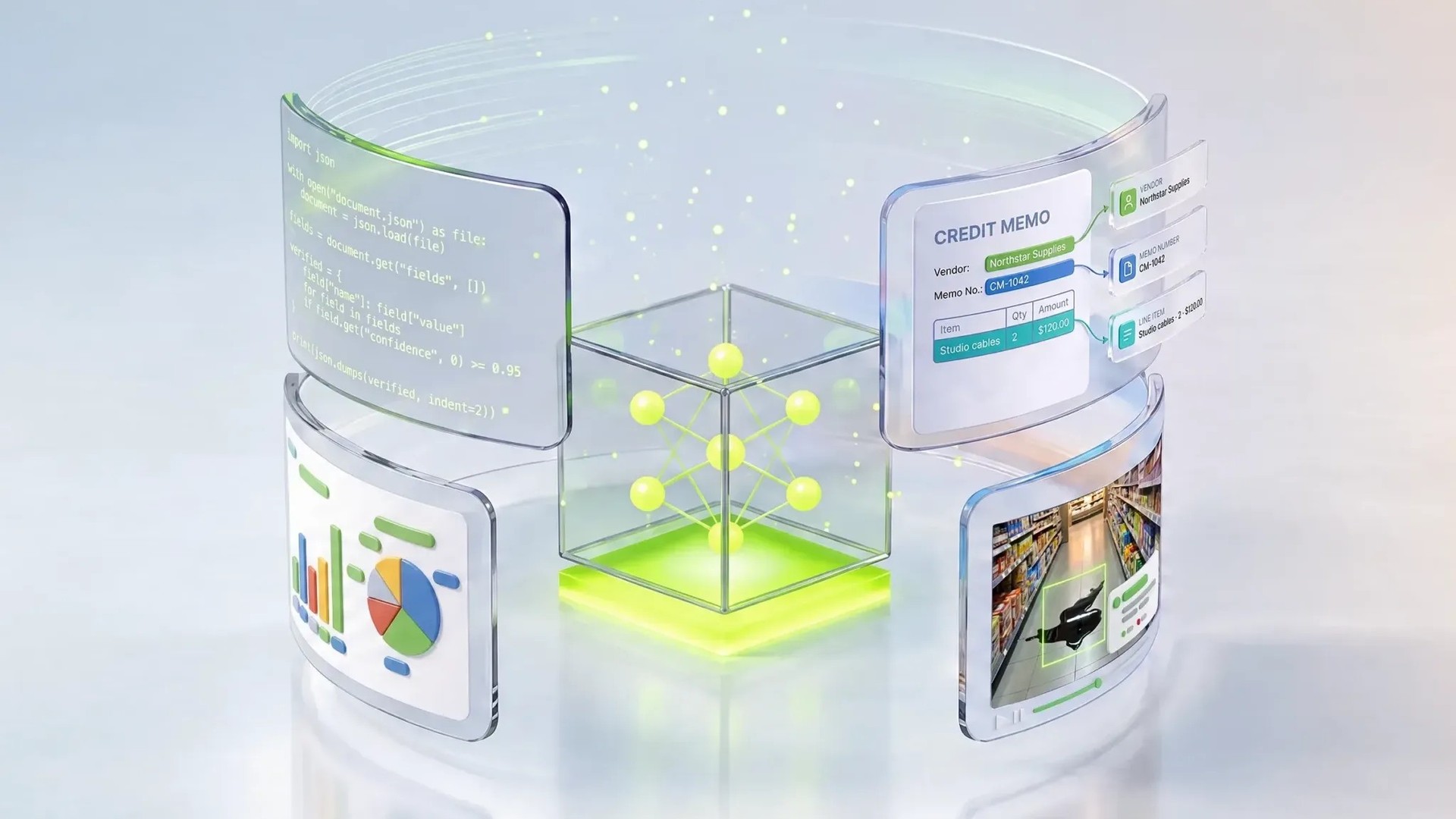
The model combines reasoning, instruction following, and tool use with text, image, document, and video understanding in a single system. According to NVIDIA’s technical blog, that integration lets teams handle text and visual tasks without deploying separate text and vision-language models or passing task context between them. NVIDIA said the model’s vision-language training targets what agents encounter in practice: optical character recognition, tables, charts, and structured information in visual documents such as web pages and PDFs.
NVIDIA’s reported evaluations show Super VL scoring 63.44% on Hermes Bench and 87.05% on LangChain behavioral evaluations, against 56.33% and 84.3% for Nemotron 3 Ultra. On CharXiv, a chart-reasoning benchmark, NVIDIA reports 80.8% for Super VL versus 63% for Nemotron 3 Nano Omni, rising to 84% when the model uses Python code interpretation. NVIDIA also describes Super VL as one of the top open models on the OCRBench v2 leaderboard, and the technical blog states that an independent evaluation by EXO Labs placed it on the Pareto frontier for accuracy and task completion time on DGX Spark.
Training and Inference Design
Super VL was distilled from Nemotron 3 Ultra, with the technical blog crediting Ultra’s coding capabilities and the SkewReverse loss used during distillation for improved coding accuracy. During post-training, multi-teacher on-policy distillation combines guidance from specialized teachers across text and vision, with the teachers scoring the model’s responses for video reasoning and tracking, vision tool use, and alignment. The technical blog also notes contributions from Nemotron Coalition organizations: datasets from Perplexity supported the model’s mid-training, and environments from Prime Intellect were used to build teacher models.
Nemotron 3.5 Super VL was trained on about 26 trillion tokens across pretraining and continued pretraining, then post-trained with roughly 3.8 million samples and reinforcement learning across dozens of environments. Continued pretraining added 10 billion Indic tokens, and NVIDIA is releasing a dataset of about 2.8 trillion tokens across 22 Indian languages developed with IIT Madras and its AI4Bharat lab.
The release includes base, post-trained, and NVFP4-quantized checkpoints. The NVFP4 recipe uses 4-bit weights and activations on NVIDIA’s Blackwell architecture, paired with quantization-aware distillation intended to close the accuracy gap that quantization introduces. An open speculative decoding technique called LiLiCorr delivers up to 2.3x faster token generation than decoding without speculation on DGX Spark, NVIDIA reports. Multi-token prediction gives the model an internal drafter that proposes several tokens for verification in one forward pass, and context-reuse serving optimizations preserve both attention caches and Mamba recurrent states across repeated agent calls.
Bolt Models at the Edge
Bolt 74B-A9B 24GB uses native 2-bit quantization to fit in 24GB of memory and run locally on NVIDIA RTX and DGX Spark alongside other applications. NVIDIA describes it as the top open model in its class on PinchBench and the second-ranked open model on BrowseComp. The model is available on Hugging Face with support for llama.cpp, Ollama, LM Studio, Unsloth, and vLLM. It is built for NVIDIA RTX Spark laptops arriving October 16, 2026, and also runs on GeForce RTX PCs, DGX Spark, DGX Station, and RTX PRO workstations.
Bolt E4B 4GB targets physical and conversational agents on GeForce RTX, Jetson, and RTX/DGX Spark, combining natural conversation with multi-turn agentic capabilities for local voice assistants, interactive characters, and embedded interfaces.
Customization, Early Adopters, and Deployment
The model ships with open weights, open datasets, and training recipes, with customization supported through NVIDIA NeMo, Python-based pipelines, and open datasets. NVIDIA is releasing open datasets on Hugging Face spanning agentic tool use, finance, instruction following, long context, fairness, and 45 vision-language datasets, along with reinforcement-learning environments in NeMo Gym.
Dozens of organizations are post-training Super VL on their own data, tools, policies, and workflows, according to NVIDIA. Scale AI post-trained the model for Skydance’s vendor credit finance agent and EY’s M&A due diligence agent; the technical blog states that inference cost for the Skydance workload will decrease by 40x and latency by 5x. AfterQuery customized the model for Hebbia for credit agreement analysis, and AI21 and Alice post-trained it for cybersecurity attack resilience, with NVIDIA reporting 40% higher accuracy for Alice’s threat intelligence and vulnerability analysis. Mercor post-trained the model on the APEX-SWE coding benchmark for coding agents that plan, write, and debug code. Ramp is converting receipt images into structured JSON containing merchant information, dates, and payment data, and expects up to 50% higher throughput and 10x lower latency, according to the technical blog.
Software platform companies integrating Super VL include Atlassian for agentic search across apps such as Jira and Confluence, CrowdStrike for agentic blue teaming in enterprise security, Dassault Systèmes for engineering design and simulation, and Perplexity for search and agentic tasks. Salesforce is customizing Nemotron to power AI agents that digitize and automate government workflows through Missionforce Operations, and Synopsys software for semiconductor design verification interoperates with the model.
For deployment, NVIDIA NIM packages the model as a production-ready microservice refreshed every two weeks with security patches and performance improvements. NVIDIA reports that on 16 B200 GPUs at 50 tokens per second per user, Dynamo serving with KV-cache-aware routing serves up to 8x as many users while reducing first-token latency by 85%. Super VL is available now on Hugging Face, OpenRouter, ModelScope, and as NVIDIA NIM, running across DGX Spark, DGX Station, RTX PRO and RTX systems, Jetson, and data center and cloud environments.